Blacksmiths of the Middle Glens and their Families
By Malachy McSparran Glynns Volume 29 (2001)
This article is a reprint of one of our most popular articles by founder member Malachy McSparran, previously published in 2001.
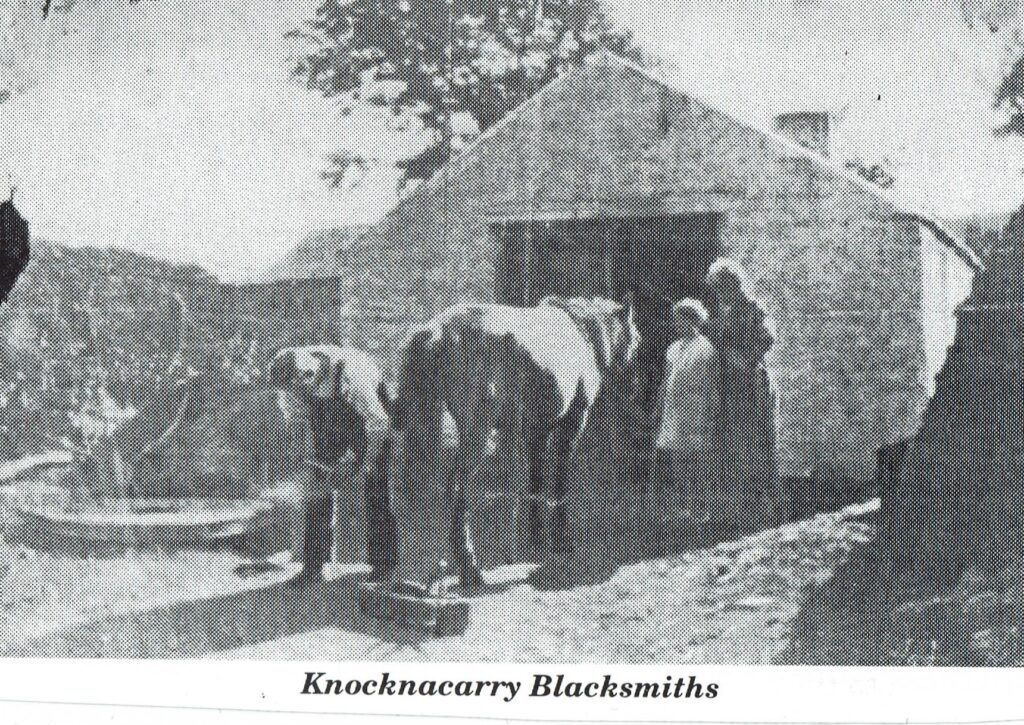
Up until about fifty years ago the trade or profession of blacksmithing was a very common occupation in the Glens and indeed in every part of the country. The introduction of the tractor and the mechanisation of farms meant that the service offered by the country blacksmith was no longer required. Gradually those that carried on the business died out, so that by 1960 there were no blacksmiths operating in the area that at one time had up to a dozen or so men employed in the trade.
Thomas McKiernan was originally from the townland of Kinune in Glendun. At the time of building the Coast Road he moved his smithing business to a house in Craigagh Wood. There are a number of old ruins here and they are known as the ‘boley houses’. The building which Thomas McKiernan used, can still be located. Although there is no roof on the structure the wall is pretty much intact and the bench and the site of the furnace can still be seen.
Undoubtedly, there would have been a good deal of business for the smith at the building of the road. Apart from the attention the horses would have required, there would have been implements which would have needed sharpening, tools needing repairs, carts and barrows needing to be maintained and iron work needed for bridges, culverts and gates. Across the road from the ‘boley houses’ there was a large compound for storing tools and implements. It can still be seen today.
By the 1850’s, and with the road having been completed, Thomas McKiernan moved to the neighbouring townland of Clady. He was there in 1851, when his two sons Michael and Thomas enrolled in the newly opened Knocknacarry National School. By the time of the Griffith Valuation 1860, Thomas was back in Kinure.
Thomas McKiernan died in 1870. None of his family took up the blacksmithing trade. His son went to Ardrossan where his wife, Ellen McGarry, had a sister.
About one mile from Clady in the townland of Barmean, where the house now occupied by Margaret McMullan stands, a family of blacksmiths named McKillop operated. The father Alex, was certainly in business in 1852, as the Knocknacarry School register shows. He was still there when the Griffiths Valuation was carried out eight years later. One of his sons, Alex, moved to Ballyvoy to smith. In 1899 after the birth of his youngest child, his wife died and his five daughters were fostered with different relatives. Alex McKillop gave up smithing and went to sea. Unfortunately, Alex himself drowned off a ship in Glasgow, less than a year later. His body was removed and he was buried in Craigagh cemetery. Alex’s sister Margaret and his brother John reared four of the children. The other girl, Kate, later Mrs Austin, was reared with another aunt and uncle in Knocknacrow.

Alex McKillop, (senior), was succeeded by his son John at Barmean. In his early days John had gone to sea, but settled down as a blacksmith with his sister Margaret and his four nieces.
After John’s death in 1919, the forge closed down.
A few hundred yards from the McKillop forge and in the same townland, another family of blacksmiths operated. These were the Laverty’s. The first we know of, was James Laverty who was there in 1855. In the Griffith Valuation (1860) James Laverty has a house, small garden and forge. James Laverty was succeeded by his son Mickey, in 1894. The corner where the forge was located is still known as Mickey’s Corner. Mickey Laverty was a well-known character and was considered something of an expert in treating sick animals. He died in 1935 aged 83 and, as he had no family, this forge was also closed.
On the other side of the River Dun at Straid, James Stewart had a blacksmiths shop. Local tradition asserts that his family was one of the retinue of servants that accompanied Bonny Prince Charlie on his flight from Scotland. Tradition also asserts that the Prince himself, spent a night in Mullarts.
When James Stewart commenced business is not known, but he was operating in 1852 as is evident in the Knocknacarry School Register when his children entered the school. In the revision of valuations, it is stated that by 1864 the forge was closed and that the owner of the premises was now Daniel McDonnell.
At the same time there was a blacksmith called Patrick McGill, in Knocknacarry. (He had for a nickname ‘the Brasher’). His children also entered Knocknacarry School in 1852. The Griffith Valuation states that Patrick McGill had a house, forge, office houses and small garden. By 1880 the forge was closed. It is not known where the family went.
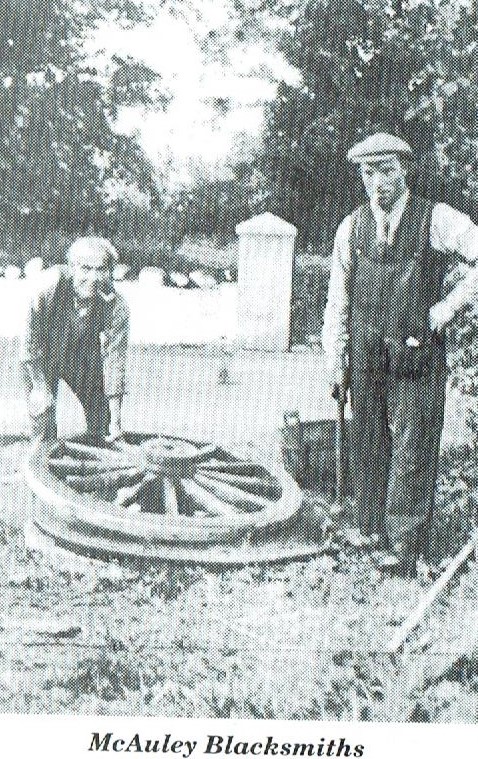
Charles McAuley, a Ballyeamon man, learned his trade with his relatives, the McCormick’s of Cushendall. Charlie subsequently started on his own in the 1870’s at Joe McCollam’s yard at the back of the Public House in Cushendall. Apparently the police were not happy with the location of the forge and accused him of selling drink illegally. Charlie then moved to Knocknacarry to the premises vacated by Patrick McGill. The McAuley family were to remain as blacksmiths in Knocknacarry until the mid-1950’s. The original location of the forge, where McKay’s shop stood until recently, had to be changed when the McKays started to build a house and shop on the site.
A new forge was built on an adjoining site. This forge remained here until 1995 although it was derelict for about 40 years.
Charles McAuley died in 1934 but by this time his son, also named Charles, had taken over the business. This second Charles, married to Kate McLaughlin from Knockban, died in 1962 and his wife one year later. They had only one daughter, Mary.
There is evidence from Knocknacarry School Register that these were at least two other Blacksmiths in the Cushendun area. Charles Hamilton of Ballyteerim, born in 1840 was registered as a blacksmith’s son. There is no further information on this family although an outhouse in Ballyteerim is still referred to as the smith’s shop.
The other reference is to a smith named Harrigan of Ardicoan. He had a son Daniel registered as entering Knocknacarry school in 1852, aged 15. It is likely that this man came from another part of the district and like Thomas McKiernan, was working on the building of the road, known as the ‘Corkscrew’. Nothing further is known about this family and by the time of the Griffith Valuation they had moved away.
Also in the Griffith Valuation there is reference to two Mooneys in the townland of Cushendall. Thomas Mooney and Michael Mooney both had houses, forges and small gardens. These forges were located among the row of houses along the river at the bottom of Gaults Road. Michael Mooney was the great grandfather of Margaret McCurry. Margaret always heard that his forge was at the end of the row away from the road, and indeed there was an anvil there until recent times. Thomas Mooney was possibly a brother, but while Michael and his family carried on the business, Thomas did not.
Michael Mooney later moved to the crossroads at Cairns, although in the 1901 census he is described as a farmer. At this time the blacksmith in Cairns was Cornelius McCambridge. He was better known as ‘Knochur’ (the Gaelic form of Cornelius is Conchur). Cornelius had six of a family, three boys and three girls. He died in 1924, aged 72. His son John Knochur carried on the business for a time but in his later years worked as a farm labourer. He died in 1944 at the age of 74. Another son, Toby, became a barber in Ballycastle. The house where the McCambridges operated their forge is still standing at the roadside in Cairns.
The family of McIlroys was a long established family of blacksmiths in Cushendall. Their forge was along the river at the bottom of Shore Street. Hugh McIlroy was the first mentioned in the Griffith Valuation. He was succeeded by James around 1887. In the 1901 census James McIlroy was 57, his wife Mary was 50 and there was a family of Kames, 28 also a blacksmith, John, 23 a gardener, Joseph, 20, also a blacksmith, Kate, 17, a cook, and Maggie, 16, a schoolgirl. Joe mentioned above, worked for a time as a blacksmith, with McBrides of Ballyvoy.
Griffith’s Valuation located another blacksmith in Cushendall. This was on High Street at the house where Charlie McLarnon had a bakery. This family was called Nicholl. He died in 1877 and was succeeded by his son Robert. The latter was succeeded by his brother Denis. How long the Nicholls carried on as blacksmiths is not known but the Nicholls became coal merchants, importing coal in their own boats. Only two of the family are noted in the 1901 census, John who is described as a mariner and Robert who was a gardener. One of the family, James, emigrated to San Francisco. The last to die was Robert at the age of 86, in 1938.
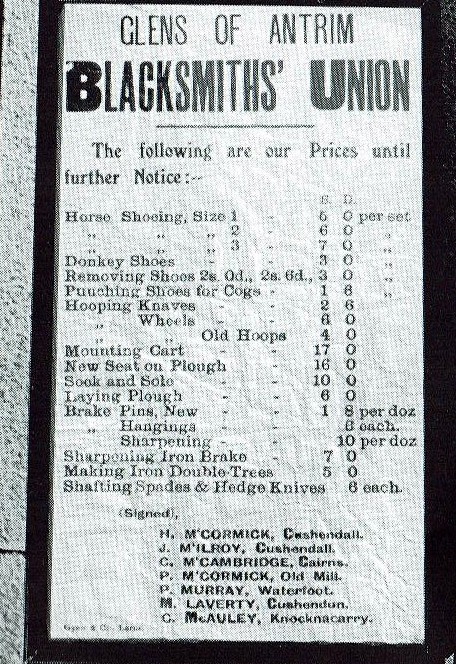
Another long established family of blacksmiths in Cushendall was the McCormick family of Bridge Street. Their premises, at the entrance of the carpark, was demolished in the 1950’s. The first of the family known was Patrick who was born in 1831. He had two sons in the business, Henry and Patrick. Henry, born 1882 carried on until the 1950’s. His brother Patrick, worked for some time in the Old Mill, possibly at the same location where Michael Mooney first operated.
Around 1930 the Farmers Union branch in the Glens was instrumental in having a blacksmith established at the back of Mill Street in Cushendall, in the yard of what is now Harry’s Restaurant.
This man James McAllister who came from Carnalbanagh, near Glenarm. He was reckoned to be a first class tradesman. James McAllister had two sons, one of whom emigrated to America and married Josephine Murray of Straid. The other son died young.
James McAllister died while he was still working in Cushendall. The business was carried on for a short time by Willie McNeill who came from the Braid.
In the townland of the Warren at Waterfoot a blacksmith’s shop was operated by the Murray family of Parkmore. In 1893 No. 25 (a) the Warren was occupied by Patrick Murray and included a forge. Patrick Murray died and was succeeded by his son Alex who lived on the family farm at Parkmore and cycled each day to the forge in Waterfoot. Alex was the last smith, and the business closed on his death in 1966.
‘Opposite Annie Graham’s house, in the townland of Clonreagh, is a small building still known as the Blacksmith’s Shop, because it was here that Johnnie Laverty carried on the business his father had done in Cushnilt’. This information comes from ‘A Glimpse of Glenariff’ by Robert Sharpe and Charles McAllister. There is no reference in the Griffith Valuation to a blacksmith shop at Cushnilt, so it must only have operated for a short time. It is said that the Laverty family may have been related to the Laverty’s of Barmean. John Laverty (sic) had a house, offices forge and yard in Clonreagh in 1885. By 1911 the occupier was James Leitch. John Laverty is believed to have married a McKillop of Gortacreggan, Cushendun, and emigrated to America.
The only other blacksmith mentioned in Glenariff was at Tamlaght. Here, a Henry Gillian had a forge, office and yard, according to Griffiths Valuation. The Revision of Valuations show that the forge lasted until about 1880, because the following year a note states that the forge closed down.
Undoubtedly, there were other blacksmiths in the Middle Glens which have not been recorded here, as there is little or no information about them. There was supposed to be a blacksmith operating in the caves at Cushendun and likewise a blacksmith in the caves near the Red Arch but it has been impossible to ascertain the names of these men.
Finally, the most famous smith of all the Glen’s was Robin Kennedy, immortalised in Dusty Rhode’s poem ‘The Smith of Tiveragh’. If he existed at all, and there is no documentary evidence that he did, it is believed that he had his forge at Red Bay village. According to the ballad Kennedy specialised in making pikes for use in the ’98 Rebellion.
‘The anvil rings in Robin’s forge, rightly cheerily I ween,
And close beside him lies a pile, of pike heads sharp and keen,
For he within the smithy, had toiled from break of day,
And now his task nigh ended, his heart is light and gay’.
How much is legend and how much is fact is hard to judge, but John Hewitt in his poem ‘Fame’ seems to believe that there is substance to the tale.
‘But yon’s the smiddy, yon’s the place,
The blacksmith led the Yeo’s their useless chase;
And where John Kane’s land marches with Leamore.
This is a thing ye didn’t know before
A gate the blacksmith made is swinging yet’
The blacksmith’s forge is a thing of the past. The buildings which survive have been turned over to other uses The clang of the blacksmith’s anvil which was a familiar sound in the countryside is silent. The few horses which remain in the Glens are now shod by a travelling farrier. The blacksmith shop which was a sort of social centre where waiting customers exchanged news, gossip and opinions is no more.
(I have made extensive use of the Griffith’s Valuation and the Revision of Valuations (val 12/b), which can be consulted in the Public Records Office, Belfast. I am grateful to Donal McAlister, Cushendall for making available the register of blacksmith’s in the Glens. I would thank those glens people who shared memories of the blacksmiths with me). Malachy McSparran
Volume 29 can be ordered from our web-site bookshop priced £5.00 plus postage