“This ends the Broth Shop.
God save the King.
And we pray the like calamitous time never again to see.”
Thus closed the financial accounts of the Glenarm Broth Shop on 28th August, 1817. The poignant supplication however, was not granted: exactly thirty years later Ireland was again in the grip of famine, the Great Famine, and once more Glenarm had to run a Soup Kitchen for the relief of its poor. Fortunately the Account Books of both these undertakings are extant, though the later one is incomplete. They give a detailed contemporary picture of how each was launched, and an insight into the day-to-day mechanics of their working. It is the object of this article to examine them and show how the dread scourge of famine was tackled in this part of the Glens of Antrim.
It is an acknowledged fact that the famines of the early nineteenth century did not strike this north-eastern-most corner of Ireland with the same severity as elsewhere. Nevertheless, if there was not actual starvation here, there was very real hunger. This was due, not so much to the actual absence of food, as to the fact that many farmers and cottiers normally dependent upon their own home grown potatoes, could not afford to buy other forms of nourishment when their potato crops failed. The essence of the local famine relief schemes therefore, was to purchase other food in bulk and to distribute it amongst those residents who were unable to pay for it.
As these schemes developed naturally from the manner in which the parish had previously cared for its poor, it is relevant to inquire at this point how this had hitherto been done. At the Easter Court of Vestry, which was obligatory, the church officers were annually elected by the parishioners for the ensuing year. These included the applotters, whose duty it was to applot, or allocate, to each family in every townland in the parish its share of whatever money the Vestry decided to raise during the year. This allocation was done on the basis of the relative value of each family’s land and dwelling, a method which still forms the foundation of our local taxation system today. From time to time the Court of Vestry met to deliberate and enact upon what moneys were to be raised and how they were to be spent. The Vestry Minutes for the parishes of Tickmacrevan and Templeoughter, or Glenarm (P.R.O.N.I. Mic 1/72) go back as far as 1718, but it was not till 1744 that there appeared any entry concerning money being raised in support of the poor. In that year it was enacted “that the sum of two Pounds Sterling be forthwith applotted and levied off said Parishes for the support of an Orphan lately left in this Town and one Shilling and one penny for flannels purchased by the Churchwardens for its use.” (9th April, 1744). There followed a series of similar enactments for the support of foundling, orphan, and bastard children of the parish.
In 1759 the first entry concerning the raising of money in support of an adult poor person appeared. “That two pounds be levied for ye support of Rose Alexander a Decrepit Woman.” (17th April) and a similar sum was laid on for her the following year.
From 1776 onwards, not a year went by without specific sums being applotted and levied in support of named individual poor. Of these, Francis Hood was probably the most pitiable and in sorest distress. He is described as “being a disabled object” and “uncommonly afflicted.” Between the years 1777 and 1790 he received regular support costing the parish at first £2 and then £4-4-0 and finally £4-11-0 a year. Others to receive monetary assistance were McClunies, an idiot; Patrick Dempsey, a blind man; Widow Jenning’s son, David; and Cath. McHattan, sometimes entered as Cath Muckle Hattan. These, and many others, year after year as poor to whom disbursements were made by the church wardens. So long as the poor remained names, so long as they were individuals for whom the vestry annually levied money, there could be no question of famine. But when the poor became so numerous as to be numbered rather than named, then conditions were more serious.
Things began to move in this direction shortly after the outbreak of the Napoleonic Wars and for the succeeding twenty-five years Glenarm had a hard struggle to cope with her destitute, Those wishing to benefit by any relief the Court of Vestry might offer were required to sign the following affidavit: “We . . . . . . do Voluntarily Swear that we do not hold any lands or tenements to the Yearly Value of Five pounds Sterling nor do we have in our possession, nor any person in trust for us, Goods, Chattels, or moveable Effects to the Value of Ten pounds Sterg., nor do we retail Soap or Candles or are under Licence—So help me God.” Hitherto the maximum number of poor receiving aid in any one year numbered ten. To the above affidavit a total of fifty-seven placed their signs or signatures. From this time on, the Court of Vestry were no longer concerned with the names of the needy, but rather with their numbers. This transition found precise expression in a resolution passed on 28th April, 1800, which required “that no specific sum be stated opposite the name of any poor person as before.” By the same Vestry a sum of £34-2-6 was “laid upon the Parish at large for the Benefit of the poor, to be distributed by the Minister, Church Wardens and a Committee.” The committee included David McKillip, a well-to-do Glenarm vestryman of long standing; Capt. George Stewart, Who for twenty years until his death in 1802 had been-seneschal of the manor, and since its formation, captain of Glenarm Yeomanry; Philip Gibbons, a Carnlough contractor of substance; and George Halloran who devoted his energies for almost fifty years to the welfare of the poor of the parish. In June a fund was launched, into which was paid by subscriptions from the wealthier parishioners and by church collections, over one hundred pounds, In 1801, £40 was laid on for the poor, in 1804 £15, and in 1805 £10. It seemed that Glenarm was out of trouble, and for the next twelve years there are only occasional references to the poor in the Vestry minutes. This had been valuable experience, however, in preparation for what was to come in 1817, which in turn proved to be a dress rehearsal for the Great Hunger of 1847.
The Vestry Minutes give no warning of what was coming. There had been the usual distributions after church for those on 5th March, 1817, “for the purpose of taking into Consideration the distressed Situation of the poor, and devising their Relief.” A committee was immediately appointed to raise money Within the parish and to call upon “non resident Noblemen and Gentlemen of said parish for subscriptions.” It was decided to apply to Capt. Peter Mathewson of the Glenarm Yeomanry for that portion of the Timber and Trespass fines due to the poor of the parish, that it be paid to the treasurer forthwith. It was also decided to provide the poor of the parish with badges, bearing their name and that of the parish, Whilst parishioners were “strictly enjoined not to help any who have not badges and in particular Strolling Beggars.” Having appointed a secretary and treasurer, the meeting adjourned.
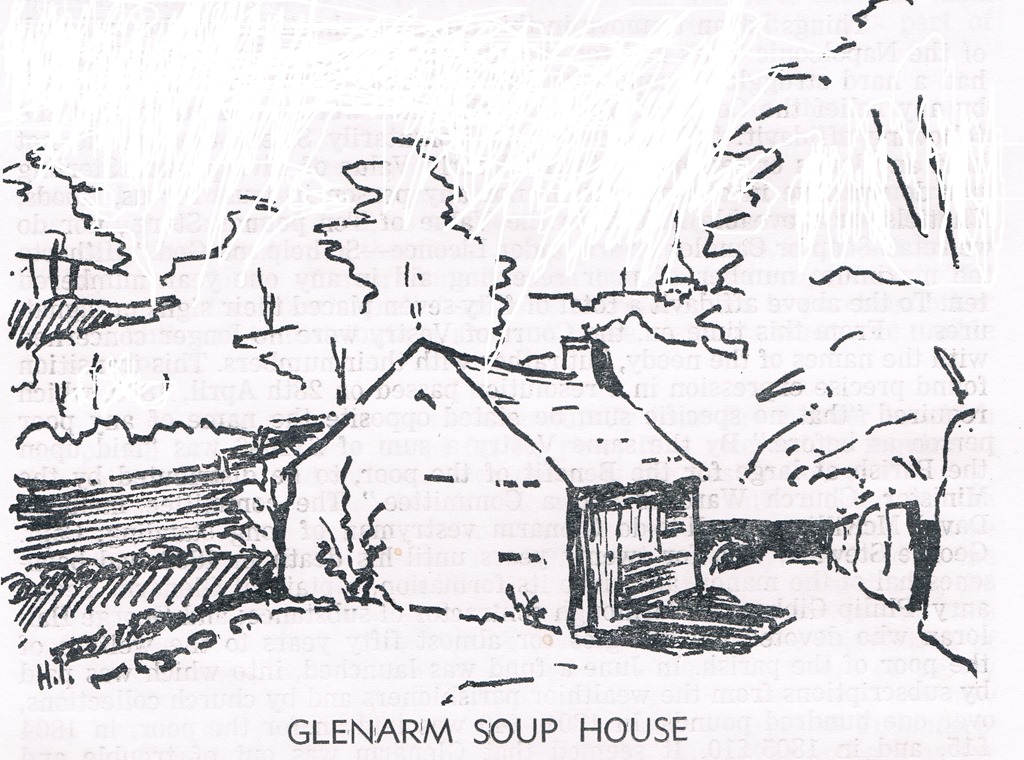
Evidently the committee decided that instead of disbursing money as hitherto, it would use whatever funds it received for the purchase of food in bulk, which it would then distribute to the needy in the form of hot broth. The story at this point passes from the Vestry Minute Book to the Parish Account Book (1804-1842) which contains the Broth Shop Day Book and Accounts. (P.R.O.N.I. Mic 1/72). GLENARM SOUP HOUSE
Money immediately subscribed by the Countess of Antrim (£25) Mr Hec. McGimny (£10), and Mr Francis Turnly (£20) enabled the committee to buy in stores and equipment. Early bills included oat meal £1-12-0 the boiler 6/0 plus 10d carriage, “nails and cord for hanging scales 4d,” “a shovel 1/3,” “one quire paper and quills 11d,” “three tin spoons 1/3,” and “one tin measure 11d.” The cook, Jane Hamill, was paid 5/10 a week, or 10d daily for a seven day week, to which was added later “the Cinders belonging to the Soup House.”
The committee met on 8th April, a couple of days before the Broth Shop opened. It drew up a roster of members who were to attend in pairs at one o’clock to supervise the distribution.It resolved “that each Member not attending in his turn as laid down in the Roster… be fined 5d. On 10th April the Broth shop opened and continued to serve daily without a single breakdown till 28th August, when the emergency was over. throughout this period all other subscriptions amounted to £15. By the Timber and Trespass fines a further £5-16-2 came in. Some few of the poor paid what they could for their soup, their total contribution amounting to £3-17-2. Other small sums included, by Colts Money-a fine of 5/- paid by Grand Jurors sitting for the first time at the Manor Court Leet –15/-, by forfeiture on seven hanks of yarn” taken from Mr Killion for being short in count at 8 1/2 d per hank, say 4/11 1/,” by Town Cess £9-14-4, and finally “by cash from Nancy McKinley for winding and reeling 2/-. In all the sum of just over £90 was raised by Glenarm, to which the government added a further £30. For this 3120 almost 200 hundred poor of the parish were sustained over a period of almost five months.
The daily pottage usually contained roughly 25lbs. beef, 10lbs. oats and 15lbs. barley boiled in 50 to 60 gallons of water. Thus, on average, each helping of one quart would contain about 2oz. beef, 1oz. of oats, and 1oz. of barley or 4oz. in all. With beef at 3 1/2 d, and barley at 3d, per lb., the average per pottage was 12/6, or about 1/4d, per helping.
In the Day Book there is a new list of the poor for each month on which their daily attendance is carefully ticked off. Number 4 throughout was simply named “Biddy”. During April, May and June, Biddy received her one quart ration regularly, but on the July list her name appears in double size print, and beside it, in small writing, “one bigger than 2”, the 2 falling in the column for the number of quarts allowed. In the August list she was again allowed two quarts and beside her name was written “A thumper.” There can have been few occasions for fun at the Broth Shop, but Biddy at least provided one. The signature of the attending supervisor was appended daily without fail along side the amount of cash taken and handed over to the treasurer, Mr Halloran. Not once was the 5d fine imposed. Mr Halloran’s work was correct to exactitude. Glenarm was fortunate to have such a capable and experienced hand at the helm. Assisted by a team of responsible and willing helpers, he saw the Broth Shop through to the end, and as the harvest began to come in, so the need for such an ‘establishment’ went out. On 28th August the treasurer closed his accounts with the poignant words quoted at the opening of this article.
During the intervening thirty years, before the Great Famine struck, the Court of Vestry continued to care for the poor as before, making monthly disbursements of cash after Sunday service to those who were eligible. this seems to have necessitated the attendance at church of would be recipients, irrespective of their creed, for whom a special pew was allocated at the front. That these distributions had not always been orderly occasions is suggested by a minute dated 8th April, 1788, which records a resolution “that no person whatever shall enter within the Communion Rail after service unless at the request of the Minister or Church Wardens, and that for the future no money shall be sent to a poor person by any improper person unless one who can be accountable for it, and that no person who has an annual salary shall be admitted to the monthly list.”
The impropriety of the Established Church managing the affairs and finances of a parish largely peopled by members of other churches began now being recognised. In 1821 this sentiment was reflected in the composition of a committee appointed by the Court of Vestry “for the purpose of superintending and seeing properly executed for the Repairs and Improvements” then being made to the parish church. These included the erection of a gallery at the west end and the building of the vestry. To this committee were appointed in addition to the incumbent, the Rev. John Hodges, also the Presbyterian minister, the Rev. Alexander Montgomery, and the parish priest, the Rev. Michael O’Hagan. Though these two gentlemen do not appear to have sat, their appointment of parochial affairs, a trend which went still further at the time of the famine.
Just before the storm broke, Glenarm suffered a double loss. Firstly, the Rev. Ross Jebb, incumbent during the preceeding twelve years was replaced by the Rev. Colin Ievers, who was therefore new to the parish when the famine began. Secondly, on 29th February, 1846, George Halloran, who had so faithfully supervised the running of the Broth Shop in 1817, died at the age of eighty-one. Within a fortnight however, the Court of Vestry took steps to forearm the village against what was coming. On 13th April, “At a meeting held in the parish church . . . . to take into consideration the propriety of taking steps to provide against the event of Scarcity of food or epidemic disease occurring in the approaching summer, it is resolved that each of the clergyman of the different persuasions in the parish be requested to preach a charity sermon for the purpose of forming funds to meet the exigencies of the case. It resolved that a committee be formed for the purpose of managing the funds to be raised as above mentioned, which committee shall consist of the clergy of the different denominations”, the two church wardens, and eight other parishioners, with powers to add to their numbers. These included the town’s two physicians, Drs. Kidd and McAuley; Lieutenant Lyons, R.N. the Coast Gunner; James Hanna and John Lanktree, the joint secretaries; and George St Halloran, the treasurer. From then on, no further reference to the committee or its business is found in either the Vestry Minute Books or the Church Accounts, though in the latter a new and frequent entry began to make its appearance. This was the payment of sums varying from 5/- to to Mr Snoddy for the coffins of sundry poor.
The business of the Soup Kitchen Committee was thereafter recorded in a thin flimsy booklet, enveloped in an improvised newspaper cover upon which was inscribed in fine Old English lettering, much too fine for the quality of the cover the words “SOUP KITCHEN, January 1847.” Though appointed in April 1846, it was not till January 1847, that the Committee began to organise a kitchen. Apparently Lieut. Lyons and Mr. Isaac Hardy had “kindly offered their services to attend daily and give out the Soups, and . . . . to provide materials for it.” At its first meeting on 12th January, the Committee accepted this offer. It decided to meet each Monday at noon, and that the issue of soup would be one quart to each parent and one pint to every child in a family. Weekly meetings were held throughout February and March when most of the business concerned the approach it should make to the Lieutenant of the County to win recognition as a “Relief Committee” and thereby qualify for assistance from Westminster, provided for by the “Relief of Destitute Persons Act in Ireland.” John Lanktree, Lady Londonderry’s agent proposed that the area covered by the Committee should include Ardclinis, and that the Rev. John Wilson of that parish, together with Messrs. Gibson, Reside and Davison of Carnlough be invited to join the Committee. However, this apparently did not suit the Carnlough people. Eventually at the instigation of Mr McDonnell of Glenarm Castle and Mr Agnew of Kilwauglrter it was decided “that a voluntary subscription be raised from the Landed Proprietors of the district, in order to meet the present want.” As a result over £100 was promised, and on the strength of this the ’Committee decided on 12th April “that the Glenarm Electoral Division should meet its own destitution without having resource to the Relief Act at present and that the Memorial (to the Lieutenant of the County) be withdrawn.”
Unlike those of 1817, the minutes of the 1847 Soup Kitchen Committee tell us little about the kitchen’s day to day running. What information there is comes from the Accounts. These reveal that between December, 1846 and April, 1847, when the landed proprietors took over, a sum of £60 was raised by forty-four subscribers and that a further £6 odd came in by the sale of soup. We may presume, therefore, that as before, some few of the needy contributed what they could for their ration. From the debit side we learn a bullock was purchased from David Petticrew for £6-5-0, that John Murphy was paid 11/0 1/2 for setting the boiler in the Court House and 3/6 for lime and drawing sand, that a quart measure was bought for 4d, and that Mrs McGookin was paid 5/- on account “for making soup.” During January the boiler proved inadequate, so a new one was installed by Mr Halloran for which he was paid £3-12-6. Peggy McKinty was paid 1/- for “2 days cleaning and scouring the new boiler.” ’Mrs McGookin was paid £1-12-6 for forty days at 10d a day with one Sunday off, from which was deducted the paid to her in December, leaving her with £1-7-6. Mrs McCambridge was paid £6 largely for barley meal, and Bryan McAllister and John McNeill were paid £5-10-0 for meat. February, March and April brought in similar bills, so that by the time the landed proprietors took over, the Soup Kitchen had cost almost £87.
The above reference to the boiler being in the Court House is the only one to come to light so far as to the actual location of either Soup Kitchen. It is possible that the kitchen used in 1817 was the tiny single-roomed cottage now standing behind the old school, built on the site of an earlier church Castle Street. That Jane Hamill was awarded as part of her wages “the Cinders belonging to the Soup House” suggests, if not confirms, this. More recently Lady Louisa, Countess of Antrim had hot soup served from here. Mr Willie Robinson of Glenarm remembers old Lizzie McKay ladelling it out there to youngsters after school, and the boiler being removed to the castle laundry at about the end of the first World War.
Having made this rather lengthy investigation, we are now in a position to draw some conclusions as to how the Parish of Glenarm was able to cope during the famine time. There is no doubt that, when the sudden pressure of scarcity due to crop failure was exerted, the experience of the Court of Vestry in caring for the poor of the parish was invaluable. Though the normal method of applotting and levying sums off the parish failed to meet the situation — such levies simply could not have been paid it was to the church that the needy looked for help, and it was in the church that men, able and willing to render the same, were found. The committees which organised and maintained both soup kitchens were appointed by the inhabitants of the parish. The men selected were largely those who had previous experience in dealing with the poor, and their devotion to duty is clearly evident. Men like the Rev. Colin levers, George Halloran, Lieut. Lyons and Isaac Handy took initiative and responsibility at personal cost to themselves. None of them were local men, but each identified himself with the community. In both famines those who had, contributed to those who had not. Remembering that in those days there was comparatively little cash in circulation, considerable resourcefulness was shown in finding means of raising money. It is significant that by the time the 1847 famine struck, all four churches were able to work together in face of the common threat. Finally tribute should be paid to the landed proprietors of the district for stepping in and. shouldering the financial burden of the soup kitchen just when outside help seemed assured. Their doing so was not entirely clear of ulterior motive however, as Lanktree’s letter of 5th May, 1847, explains. He wrote, “Application was made about a month since to the Lord Lieutenant to have these districts placed. under the Relief Act and His Excellency sent down an Inspector to organise committees and commence operations, but I thought it better to go on quietly as we were without this assistance, and succeeded in convincing the whole Larne Union, of which we form a part, it would be better to struggle for a little longer, rather than allow a heavy rate to be struck upon the District, so the Inspector was sent back to Dublin; In Ballymacaldrick however, which belongs to the Ballymoney Poor Law Union, a rate has been struck of 2/6 in the pound, the raising of which will excite an insurrection. But for my remonstrance’s we should have had the same over the Estate, and two such rates in the season would equal in amount one fourth of the Rental.”
In conclusion, remarks made by Lanktree in his 1847 Annual Report to the Marchioness may be quoted, as they hold good, not only for her property, but also for the whole Parish of Glenarm. “During this year it pleased Divine Providence to visit our unhappy country with a famine unparalleled in the annals of human suffering, which though it fell most intensely on the South and West of Ireland, was felt throughout the length and breadth of the land, and in the Glens of County Antrim smote many an uncomplaining victim. To those who lived among them, the daily observation of their actual state was very painful. Pallor and anxiety appeared on every face and. hunger, knowing no law, forced many an individual of previous good character into crime. No class felt the loss of the potato crops more keenly than the small farmers such as the bulk of the tenants of this estate, who cultivating small patches on the mountain sides depend wholly upon it for their living. For themselves and their families they usually asked no other food or higher reward for their toil than plenty of potatoes, but when these failed their condition became so deplorable that many of the resident gentry left the country rather than witness the distress.” (P.R.O.N.I. D2977/6),
I found this article very informative as the George Halloran mentioned is my direct ancestor through five generations. He is recorded as not being a Glenarm man. In our search for ancestry my family would like to know where he came from. We can trace our genealogy only as far back as George Halloran. Can anyone help? My email address is: gmohalloran@hotmail.com