Note from the Editor.
In recent years a couple of articles about the Gibbons family of Carnlough have appeared in “The Glynns” in Volumes Nos. 10 and 12. This one is the story of an adventure at sea which befell a branch of the family that emigrated from Carnlough to New Zealand in 1889. The story first appeared in the “Wide World Magazine” in August, 1920, written by one of the crew some twenty-five years after the event.
It is supplied by a descendent of the family, Mr.John Gibbons of Lower Hutt, New Zealand, who has written a short foreword to the facsimile copy of the original article.
FOREWORD
My grandfather John Gibbons, born in 1850 at Carnlough in the County of Antrim, was the son of Philip and Jane Gibbons. At an early age he went to sea and eventually became a master mariner. In 1889 he married my grandmother, Annie McKeegan of Larne. Shortly afterwards they left for New Zealand aboard the little steamer “Banks Peninsular” of which he was Master. With them sailed my grandfather’s half-brother Philip, twenty-two years his junior, who served as an ordinary seaman.
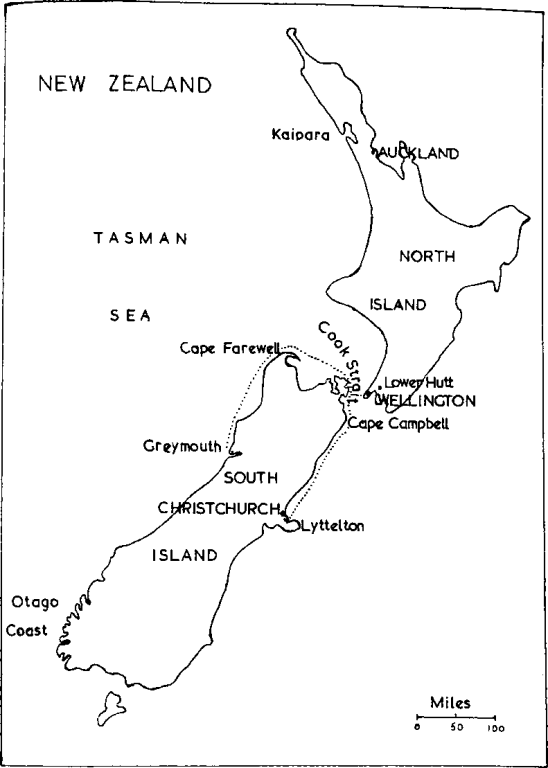
During his life in New Zealand Grandfather had interests in several ships. In 1891 he became owner of the schooner “Clyde” and in 1900 of the barque “Laira,” a much larger vessel. It was on board the “Clyde” that Lieutenant Anderson made his “First Voyage” in February 1894. This took him from Lyttleton on the east coast of New Zealand’s South Island, through Cook Strait and down to Greymouth on the west coast.
Grandfather remained active at sea until about 1904. To the best of my knowledge he received a blow to the head from the jib boom aboard ship which led to his failing eyesight and his early retirement from the sea. Unfortunately he eventually went blind and died at Devonport in Auckland, New Zealand, in 1918. This was nine years before I was born so I did not have the pleasure of knowing him. I did, however, know his half-brother Philip who lived till 1947, and of course my wonderful grandmother Annie who lived till 1940.
JOHN GIBBONS, Lower Hutt, New Zealand.
![clip_image001[4]](http://www.antrimhistory.net/wp-content/uploads/clip_image0014.gif "clip_image001[4]") |
 Captain John Gibbons during his youth in Carnlough
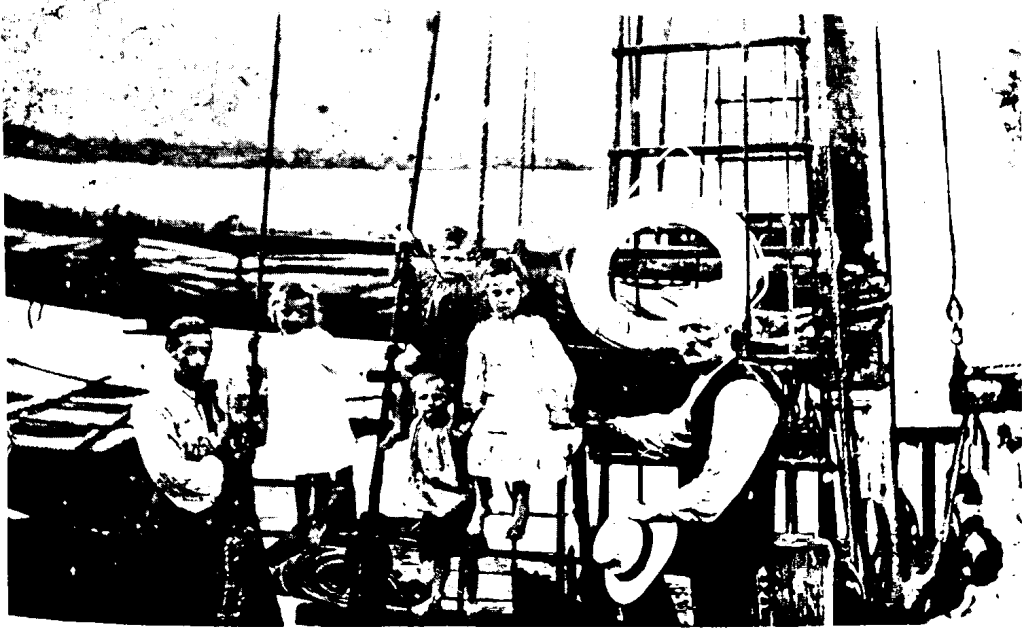 |
The Gibbons family aboard the topsail-schooner “Clyde”, c. 1896. left to right: Mrs. Annie Gibbons, Josephine, John and Hugh, Montgomery and Capt. John Gibbons.
MY FIRST VOYAGE
by Lieut. John Anderson R.N.R.
A rattling sea-story, full of the salt spray and stirring incidents. It was a touch-and-go trip, as the Author shows, and his first voyage came very near to being his last. (editor.)
It was on a drizzling morning in February, 1894, that I sailed on my first voyage to sea on board a topsail-schooner of eighty-seven tons register. We were bound from Lyttelton, New Zealand, through Cook Strait to Grey mouth, a port on the west coast of the South Island which bore a very evil reputation with reference to its bar harbour, of which more anon. Save for five tons of flour we had no cargo; and accordingly, the little vessel had been stiffened with twenty-five tons of ballast. The schooner herself was a staunch enough craft, having been built of Australian hard-wood at Clarence River some thirty years before. The master, who was also owner, was an Irishman and had been in command of deep-water ships. Tiring of the long voyages, however, he acquired the ownership of the Clyde and settled down in the coasting trade.
Now to explain my presence on board the little ship. My father was an old salt who had commanded some of the finest of the emigrant ships trading to New Zealand. At some time or other, he and Captain Gibbons of the Clyde had been shipmates, and it has always been my profound belief that my first voyage was the outcome of a deep-laid plot between the two.
I had always loved the sea and ships. Before I was twelve, I could put in a long, short, or eye-splice, and could make all the common knots and bends that are most necessary in the workaday life of a sailor. These accomplishments I learned from my father in the winter nights round the fire. Furthermore, it was my delight to sit in the thick of the pipe and cigar smoke and listen to the yarns of the old skippers who often spent an evening in my father’s house. It can hardly be wondered at, in view of such an upbringing, that when, towards the end of 1893, my father asked me if I would like to go to sea, my answer was in the affirmative.
It having been settled that I was to go to sea, my father quietly suggested one day that I should make a trip or two in the Clyde, just to get my sea-legs as it were, before going away deep-water. I jumped at the idea and arrangements were made accordingly.
It was during the process of collecting my outfit that I first entertained the suspicion of a plot. I knew, of course, that I would not want the amount of clothes necessary for a long voyage, but when the subject of oilskins and sea-boots cropped up, I was somewhat nonplussed when my father said. “You’ll not want them; the summer’s not over yet, and it will be just like a yachting trip. You’ll be in the Grey in three days.” If that first voyage of mine was a yachting trip, then I consider that yachting as a pastime has been terribly over-rated.
The mate of the Clyde was a Dane who was known as Peter. He was a smart seaman, like most of his countrymen. He had a good command of fo’c’sle English and, of course, had the usual trouble with our letter “J.” To him I was always “Yack,” from the moment I stepped on board. I had more than a notion that he was in the plot too, as from the start he in no sense kept up the yachting illusion. However, I bear him no ill-will; I learned a lot from Peter. The next in order was George, the cook. I suppose he had another name, but I never heard it. He was rated as cook and A.B., and after a quarter of a century’s experience of A.B.’s and cooks, he still ranks in my memory as one of the very best. Then there was old Mac, the very father of old “shellbacks.” Deaf and toothless and limping with rheumatism, with a patriarchal grey beard, he was yet as spry as any man on board, and would hang back for no one when there was work to be done aloft. He was one of the grand old breed of British merchant seamen that carried our commerce to every corner of the world where the wind could blow a ship.
Last and youngest of the crew, save myself, was Phil, who was related to the captain and was getting in his time to sit for examination.
So much for the crew, but the most important personage on board has yet to be tallied, and that was the captain’s wife, known to everybody as the “Missus.” A little wisp of an Irishwoman she was, with the lilt of the brogue on her tongue. Brownhaired and grey-eyed, with a thin, pale face, she looked so frail to me, great clumsy lad that I was, that I thought if I blew hard at her she would fall down. Within ten days I was to learn that within that seemingly frail body burned all the fire and spirit of her famous land. She had sailed many voyages with her husband, and on this present one she had brought the family, consisting of four children, two girls and two boys, the eldest, a girl, being four years old, and the youngest, a boy, less than as many months. So there you are; I have given you a detailed list of every living thing in the Clyde, saving the rats which made night a terror for me when I was in my bunk, and the cockroaches that swarmed in George’s little galley forward by the foremast. “They will get into the cawfie sometimes, no matter how careful I be,” I heard him once say to the “Missus,” who had complained; “but mind, I don’t think they’re unwholesome, for all that.”
The little tug was cast off once we were well clear of the breakwater, and under fore-and-aft canvas we reached down the harbour. One thought was uppermost in my mind all the time I was tying myself in knots with ropes and getting hopelessly in everyone’s way, and that was, “Am I going to be sick?” Outside, there was a light breeze from the southward, but a considerable swell was running. We had got all sail on her and decks cleared up just before dinner. Be it understood, I lived and slept down aft, and when the “Missus” told me to come below to dinner, I was much distressed to find I was not in the least bit hungry. However, I was too polite to decline the invitation, and snatching one last huge gulp of fresh air, I descended into the little cabin. There I found the “old man” already seated, and the “Missus” busy looking after the requirements of the three eldest of her family. They were hungry enough in all conscience, and clamouring for food.
“Do you like soup, Jack?” she asked me. I told her I loved it, and a great bowl, steaming hot, was set before me with an admonition from the “old man” to “watch it,” for the schooner by this time was in a frisky mood. I watched it with glassy eyes and then, dipping in my spoon, crossed the Rubicon. I reached the lee rail in time, for the ladder was close to where I was sitting, but it was only just in time. The rest of that day was a blank horror. Between trips to the rail, I lay huddled by the watertank on the fore-end of the monkey-poop.
Being wise to the sea, everyone kindly left me alone. Tea-time came round at five o’clock, but I had done with eating in this world, or thought I had. I had forgiven my enemies, said farewell to my friends, and was looking forward to my first meal of manna in a better world. Towards six it came on chilly, and I began to feel cold, which is a sure sign of convalescence. It was then the “Missus” came to me and persuaded me to go below and turn into my bunk. I rolled into it “all-standing,” feeling weak and empty, like a cask with both ends stove in. The “Missus” covered me up with a blanket, and thoughtfully leaving a bucket handy, left me with the advice to have a good sleep.
Sleep I did not, but doze I did, and a delicious warmth stole over me. It was running through my mind that it was a long time till morning, and how much nicer it was in my warm bunk than on the cold deck, when I heard the “old man” shout, “Eight bells! Call that boy.” I stopped dozing and began to think. Boy, what boy? Barring the little two-year-old and the baby in the cradle, I was the only boy on board. Through the bulkhead, I could hear the “Missus” bathing and putting her young brood to bed, and in any case the “old man” couldn’t be wanting one of his infantile sons on deck at eight o’clock at night. But then again it couldn’t be I, for I had been very ill and was yet far from strong, and it was my first night out, too. Then I heard heavy boots coming down the ladder. The luminous space that marked the sliding doorway into my tiny cabin became suddenly black, and Peter’s gruff voice called out, “Now then, Yack, show a leg; you vas come on deck and keep vatch.”
I think at that moment my boyhood slipped from me. I was needed. I was of importance. I clambered on deck and saw that it was nearly dark. The stars were mustering. The wind was fresh and fair, and the Clyde, with every stitch drawing, lifted her bluff bows and stormed at the obstructing water. Aft, the track of her glimmered white like snow on velvet. The steering chains clicked and clacked in their lead blocks, and the sea gurgled up the rudder-trunk foaming in phosphorescence about the feet of the helmsman as the schooner sat her square stern in it. Every rope and shroud was a harp string, and the minstrel wind smote with his master touch and drew forth music that filled my soul and vibrated through all my being. Aloft, the tall trucks swayed in rhythmic arcs to the cadence, and the refrain was, “Follow the sea and the wind, follow the wind and the sea.” And I, being some days short of fifteen years old, swore I would follow both wind and sea and if needs be die in their service. And because in after years I broke that oath and followed neither wind nor sea, but ran contrary to them in the things men call steamships, they, in turn, forsook me and the music died out in my soul.
We doubled Cape Campbell and stood away through Cook Strait, which stands better than stone or brass, as a memorial to the greatest British sailor of all time. It was hereabouts that I stood my first trick at the wheel. The Clyde was running “wing and wing” when, at four o’clock one afternoon, the “old man” told me to take the wheel. Now, I had steered with a tiller and with oars in boats, but a wheel I had never before handled, and to steer a schooner running “wing-and-wing” before the wind is an art at which few, if any, become proficient. The “old man” stood by me for an hour and swore by all his salt saints that he had never seen such steering in all his days and I believed him. Hard up and hard down I worked at it, till the steering chains groaned and grew hot. The sea shot up the rudder trunk and swirled round my legs up to my knees, and I wished I’d gone in a big ship with sea-boots instead of a “yacht” with slippers.
And all the while the “old man” grim and grey, stood by. “Where are you going to now?” he would say. “You’ll have that main boom over, sure as death.” Then, as I clawed the wheel round, making her swing back with a rush, as if she’d forgotten her port of registry and wanted to refresh her memory by a peep at the name on her square stern, he would vary it with, ‘Now, where are you going to? You’ll carry away that fore-boom guv-tackle and broach her to. Oh! my Christian grandmother! such steering I never have seen in all my days at sea.” And I, with rage in my heart and tears in my throat and eyes, slaved at that cursed wheel till the sweat poured out of me. Cruel, you say? Not a bit of it; he was only developing the plot! A kinder-hearted man than John Gibbons never trod a deck — and the joke of it was, I learned to steer.
We had bad luck in the Straits, for the wind came away from the westward, and we had to beat our way through. My hands were by this time in a sorry state with sea cuts. All the schooner’s running gear was coir, and I know of no more exquisite agony than is occasioned by the hauling on such ropes, when one’s hands and fingers are flayed raw with friction and pickled with the brine of the sea. For one day we lay in shelter behind Guard’s Bank, and in the evening the “old man” had the boat over, and leaving old Mac in charge, took us all away fishing. Rare sport we had hauling in the rock cod two and three at a time, with an occasional grey gurnet to vary the monotony. George, to wind up with, hooked a shark six feet long, and the mess it made of our lines before we could kill it put an end to our fishing.
I think it was on the morning of the ninth day out that we cleared Cape Farewell. We were then within measurable distance of our port, but there was still something in store for us, before we could warp the Clyde to a safe berth alongside the wharf at Grey mouth. The wind came away from the north-west and steadily increased, till by noon a heavy gale was blowing. With the exception of the sounds on the Otago Coast, where there is little or no trade, the ports on the west coast of New Zealand are almost all river ports, with dangerous bars to be negotiated before the harbour is reached. Of all those bars the most dreaded are Kaipara in the north and the Grey in the south, whither we were bound. With a really bad nor’-wester blowing, there are many safer places than the west coast of New Zealand.
As the afternoon wore on the gale increased in fury. Our topgallant sail and fore-topsail were in ribbons, and the jib had blown away. About four o’clock the weather was so bad that the “old man” decided to heave-to. This was accordingly done, and the Clyde was hove-to on the port tack. A sea-anchor, composed of three large logs, intended for firewood, lashed together and veered out on the end of the five-inch hawser, kept the schooner to the wind.
Being so lightly laden, the Clyde was like a cork on the water, and though taking little weather sea on board, her terrific motion, as the great rollers bore down on her beam, made it a difficult matter to get about her decks. Watching the huge walls of water coming out of the smother of rain and mist, I thought each one must annihilate her, but like a bird she would rise up and up to the crest of it which, in a welter of stinging spray, flew over her mastheads, and then down and over she would go into the great gulf on the other side, her lee rail under and the water swirling to her hatch-coaming.
At eight o’clock I went below, wet to the skin, and was glad to peel off everything, and in dry pyjamas, roll into my bunk. Sleep was out of the question owing to the frenzied lurching of the ship. Had my bunk not been on the starboard side I certainly could not have lain in it. As it was, I was really only in it when the schooner lurched to windward. When the lee roll came I was shot up the side till I came in contact with the deck above. I was not called at midnight. Indeed, I think but little watch was kept on deck that night. The helm was lashed a-lee, and there was no shelter on deck for anyone, what with the hurtling spray and the water that tumbled aboard in tons whenever her rail went down.
It was somewhere about four bells in the middle watch, when it seemed to me the weather had lulled. The schooner did not appear to be lying so far over and the howling of the wind sounded gentler. I was beginning to hope the worst was over, when, with a fury I could not have believed possible, the gale came back with tenfold force.
Whether that burst in its track across the Tasman Sea had rolled up an exceptionally mountainous wave I know not, but I could feel we were being hoisted higher than we had yet been, and becoming, for the moment, more upright. She reached the top; then, as if the bottom of the ocean had fallen out, over to starboard she went and down, down with a velocity that made me feel as if I had suddenly been cut off about the middle with a sharp knife. There was a thundering crash of water overhead and a horrible rumbling roar from the hold. The cabin doors flew open, and a great mass of water rushed below. I was thrown violently on to the deck beams above. The ladder came crashing into the doorway of my berth; the lamp in the cabin went out with a smash of shattering glass. The ballast had shifted and the Clyde was on her beam ends!
When catastrophe comes suddenly, brains work quickly, even the brain of a fifteen-year-old boy. Bits of my short past, which I will suppose up to that time had been no worse and certainly no better than the average youth of my age, flashed and died like sparks at a forge. I knew we were in a tight hole and drowning seemed very possible, yet I lay for some seconds inert and waiting. Through the bulkhead came the screams of terrified children and the insistent notes of a woman’s voice in efforts to calm. I heard the “old man” plunge from his bunk and struggle uphill for the door. I heard him leap on the table in the little living cabin and by its aid scramble on deck. Then I heard him shout, “Oh! God! Annie, she’s done for! Bring them on deck!”
That shout electrified me into action. It was drowning, then, but not in my bunk if I could help it. I had a mind, too, to drown as dry and warm as possible, so, pushing up the lid of my little chest, for which there was just room between the bunk-board and the bulk-head, I fumbled till I found a pair of trousers. These I hurriedly drew on, although I had an uneasy notion at the time that they were my very, best pair. I waited for nothing else, but wormed my way between two of the steps of the ladder that was wedged firmly in my doorway.
In the cabin I found the “Missus” clutching at the weather side of the table. She was in her nightdress, and two children clung screaming to the skirts of it. By the dim light that came from the lamp in her cabin, I could see her face was pale, but then it never had much colour, and had I felt inclined to panic the calmness of her look would have put heart into me. Her hair hung straight down round her shoulders, and she looked so white and frail and so woefully defenceless that I suddenly felt brave and confident. Up through the open scuttle I caught a glimpse of a sickly moon ere a rugged mass of hurtling cloud shut it from view. I saw the “old man’s” head silvery in the light of it. Then the “Missus” called up to him, and her voice was steady and true. “Can nothing be done, Jack?” for he, too, was a Jack. At the sound of her voice, the seaman came back to him. “Aye,” he called back, ‘but I’ll want lights. Send the boy up with lamps.” Then the “Missus,” from a side locker, produced two round lanterns, and while I held them, she lit each in turn. She used but one match from a large box of Bryant and May, and I noticed her hands were like her voice, steady and without tremor. “Now, up you go with the captain,” she said, “and I’ll stay down here and pray for us all.” I mounted on the table handed up the lamps to the “old man,” and then clambered on deck.
The first thing we did was to secure the doors of the cabin scuttle, and then the “old man” shouted in my ear that we must get forward. It seemed to my inexperienced eyes an impossible journey, but there was a way, as the “old man” showed me. The schooner lay flat on her starboard side so that her deck was in the nature of an almost perpendicular wall. The lee water swirled well up to windward of her hatches, and I could have sworn I saw her lee fore-yard arm dip as the great seas rolled under her. To windward was an awesome panorama of moving mountain ranges of raging sea. Slowly and with an awful majesty they came on, rolling like inexorable destiny on the weather-beam of the devoted Clyde. By the pallid light of the moon, which the mildly driving clouds gave us an occasional glimpse of, I could see their foaming crests gleaming like snow.
“If one of those breaks on board, we are done for,” the “old man” shouted, as we clung to the wire man-rope on the weather railing of the poop; and I knew he spoke the truth. But they did not break on board but, like snarling wolves, bit at the upturned bilge of her and thrust her to the clouds, then down and ever down, forcing her over on her lame side.
Gazing at it all, I could understand and sympathize with the gaunt, rugged man at my side who, fine seaman though he was, became for the moment unnerved and sent up that despairing cry when he beheld his little ship lying like a beaten dog at the mercy of those terror-ridden seas, any one of which might, at a moment, sweep him and his fortune and what he held dearer than all into eternity. The wind shrieked and howled about our bare heads. The air was thick with hurtling spray that struck and stung our faces like hailstones and drenched us to the skin.
The “old man” led the way to the weather main rigging, and crouching for a moment to shelter under the low bulwark, explained in hoarse shouts to me that our only road lay along the outside of her. “Hang on tight,” he warned, “and do not get the lamp broken if you can help it.” So, he carrying one lamp and I the other, we clambered outside by the main-chains and made our way along on hands and knees and sideways like crabs, clutching at the gunwale and keeping our precious lamps inboard for shelter. It was an eerie and a painful journey, and looking down on the submerged deck as we slowly edged along. I marvelled that she floated at all.
At the fore-chains we climbed inboard again for here, owing to the sheer of her, the deck was comparatively free of water. We gained the scuttle leading to the fo’c’sle and went below. We found the men already hard at work by the light of a candle tearing down the bulkhead leading to the hold. Each man seemed to know exactly what to do, and almost without orders the work went on till, by aid of crowbar and hatchet, two of the heavy planks were prised out, the great nails in them shrieking in agony at such rough dentistry. We filed through the opening into the utter blackness of the hold, stumbling over dunnage and stubbing our toes against great chunks of that unlucky ballast, till our eyes became accustomed to the circumscribed limit of vision formed by the all-too-inadequate lanterns. What a contrast it was to the grandeur of the deck! I believe there was not one of us who, from the noisome hold, foul-smelling and silent save for the ominous swish of bilgewater and the groan of straining timbers, and beyond the range of our puny lights black at the grave, would not have been glad to retreat and return to the clean fury of the battle overhead. But down here lay the cause of disaster, and down here were the tools whereby, had we but the heart and the muscle, we might yet overcome the storm.
After we had hove-to in the afternoon I heard Phil say that he would feel a lot happier if there were only shifting-boards below. At the time the words had little meaning for me, but now I understood the full significance of them. There was no fore-and-aft division of boards, and for lack of a few deals, the schooner and the lives of all on board were now worth just the price of the missing shifting-boards. I am passing no stricture on Captain Gibbons. The ship was his own, competition was keen, and freights, owing to the ever-encroaching steam, were poor. Also, timber for shifting-boards cost money and took up a lot of valuable space when not required. Moreover, he was bred in a school that was used to taking risks.
The “old man” ordered me to sit up to windward and hold the lamps so that their light showed to the best advantage, while the men seized shovels and commenced on the herculean task of shovelling the ballast back to the weather side so as to bring her upright.
Although my allotted task sounded simple, I found it by no means easy of performance. The ship was so far over, and her motions were so erratic, that it was with the utmost difficulty I could keep a steady position to windward. At length I got my heels against an ill-fitting limber-board, and, bracing my back against the weather bilge, endeavoured to the best of my ability to carry out my instructions, although every lee lurch threatened to capsize me on my head. Thus perched, I looked down on the men where they laboured, crouched up under the deck on top of the treacherous ballast, while the captain directed their labours and encouraged them on to every effort. From the cabin aft came the occasional scream of a frightened child, and my thoughts would stray to the brave little “Missus” on her knees with her young ones round her, pausing in her prayers to soothe and comfort. Surely the hardest task of all lay with her that night.
At first the men made little progress, for the Clyde was round in the bottom, and as fast as they shovelled the ballast over to windward, just so fast would it slide back to leeward as the schooner lurched to the scend of the sea. Big George, stripped to the waist, worked like a hero till I saw his great back grow shiny. And, indeed, they all worked splendidly, but George was the most powerful and his shovel seemed to hold more and to rise and fall quicker than any of the others. Once, taking a huge lunge, he missed his stroke as the schooner reeled to a sea, and he fell clattering with his shovel away beyond the limit of the light. Now, George was by no means a profane cook; indeed most of his oaths and mind-easing expressions took the form of blessings. “God bless America,” he would say, or “God bless the ducks of Noo York City.” Just why he showered so many benedictions on the opposite side of the Atlantic, I do not know, for I believe him to have been a man of Kent, and he would often attest his loyalty to the British reigning house by a hearty “God bless the Dook of York.” But on this occasion he may have felt the need of more vigorous verbiage wherein to express his opinion of a somewhat novel occupation. Whatever the reason, as he fell he commenced to swear long and lustily and with remarkably little repetition. A smile appeared under the grizzled moustache of the “old man,” and I saw Phil glance admiringly into the gloom where George had disappeared. Peter laughed loud and paused in his stroke to call out, “Vat’s the matter, George?” Only old Mac made no sign but swung his shovel with steady rhythm.
George’s exordium came to an end as his shovel bit the ballast again, and after that things went with a freer swing. Hearts seemed lighter, there was a livelier clatter among the shovels, even the lights appeared to burn brighter, as if the breathings of George had rarefied the air.
I could feel by the easing strain in my muscles which had been exerted to the utmost to retain my position that the schooner was getting more upright. The ballast was flying from the vigorous shovels and the air was full of dust and grit. We were beginning to think we had won the upper hand when we felt her begin to climb a monster sea, lurching to windward as she went up the side of it. It must have been such another as hove her down in the first place. Would she never stop going up? She seemed almost upright now, and to my eyes, lying there on my back, the deck-beams came into almost normal position. The “old man” grabbed at a stanchion and cried, “Look out!” She was up, and paused. I saw the men dig in their shovels and brace themselves for the leeward scend. She started to glide and then, like the car on a switchback railway approaching the steepest dip, she swooped for the bottom of the great sea valley. In that terrific rush the labour of two hours was undone, and as she settled back on her beam-ends again, I was shot like a stone from a catapult from my position to windward. I picked myself up among the ballast with my precious lamps. Both of them had gone out, and one was broken in the fall. Water poured down the fo’c’sle scuttle, and squirled through the gap we had made in the bulkhead into the hold. Someone — I think it was Phil — cried out. “She’s gone!” and the poor little mites in the cabin screamed in terror. There might have been a panic, but old Mac who, up to this, had spoken no word, growled, “Gone be hanged! Strike a match, somebody.” How he knew she wasn’t gone or going, I don’t know. I myself felt sure she was, but perhaps the instinct of the old seaman told him his time had not yet come, although I believe he was then over seventy years of age.
Again he clamoured for a match, but though everyone was searching feverishly, not a match was to be found. “For God’s sake, get a light one of you,” the “old man” cried, and Phil stumbled away, calling out that he would get a match in the fo’c’sle. “And bring back another lamp,” cried Peter, and Phil answered, “Aye, aye,” and blundered away. That was the hardest part of all — sitting there in the black hold waiting for light or the end. Phil could not have been away many minutes, certainly not more than five, but to me they seemed an eternity. I could have drowned on deck, I believe, without a cry. Even in the cabin, with the “Missus” for example, I thought I could have faced it, but here, in this terrible black hold it was awful to contemplate. It was with a joyful heart that I welcomed the glimmer of a lantern heralding Phil’s return.
The broken lamp was found to be still serviceable, and it and the other one, when lighted, were hung with the one Phil had brought to nails in the deck-beams, and by the additional light the men turned manfully again to their heavy task. Then the “old man” called to me to come aft and assist him to shift the flour over. It was in handy bags of fifty and one hundred pounds, and had been stowed forward to the cabin bulkhead. The bags had been thrown bodily over to leeward when the ballast first went and now lay higgledy-piggledy and awash in bilge-water. “A lot of it will be of mighty little use to the baker now,” said the “old man,” “but for our purpose the bags are all the better for being heavy with the water.” I was glad to be so actively employed, and to feel that with every bag I dragged across to windward I was solidly helping in getting the old Clyde into a seaworthy condition once again. It was very close and hot in the hold, and what with the dust and grit from the ballast that filled the air, everyone was athirst. Phil, accordingly, made a trip to the deck and brought down a bucket of water from the galley. He reported the weather moderating, which cheered us all, but he made George inexpressibly sad by telling him that his beloved little galley was in a state of ruin.
And so, without further mishap, the long, anxious night wore through and by seven o’clock we had got her straightened up. “Well done, boys!” said the “old man.” “She’ll do now; let’s get away up and see about some breakfast,” and George, promising us “cawfie,” as soon as he could get his stove going, led the way. I went on deck with the rest and saw that it was a misty, wet daylight with a sullen, threatening sea, but with much less wind. All this time I had been barefooted, and as I stepped on deck, the salt set up a smarting in my feet which made me keenly aware that in places I had cut them on the jagged stones among the ballast. Getting the “old man’s” permission to go below, I dived down to search for socks and boots, and found the “Missus” in the cabin, smiling and cheerful, laying the table for breakfast. As I was about to speak she laid a finger to her lips and whispered, “Be as quiet as you can; they’re all sound asleep, the poor wee things.” What a woman she was — not a thought for herself after her terrible experience! So passed the ordeal of the ballast. That of the bar was yet to come.
Some little time before we finished in the hold, the “old man” had made a flying visit to the cabin to see how the “Missus” fared and to tell her the result of our labours. He had stopped long enough to square things up a little and had wrenched the ladder out of my doorway and restored it to its proper place, so that I had a clear passage into my little berth. I was in a sorry pickle, being wet and indescribably filthy, but thinking I might be wanted on deck, I wasted no time on an elaborate toilet. I saw that my first pair of tailor-made long trousers were irretrievably ruined. They belonged to my brand-new reefer rig-out, in which I had so proudly joined the ship. For shore-going purposes they were now useless, and I could only bless the forethought that had ordered two pairs with the suit. I found some dry socks and over them pulled my only boots, which were a pair of soft, thin-soled, shore-going articles, and so shrunken and sodden were they with rain and salt water that it was with some difficulty and no little pain that I managed to force my feet into them. I had just got them laced up, when the “old man” shouted down the scuttle, “Bear a hand on deck, Jack; we’re making sail.”
I was up on deck in a trice, and found the “old man” casting off the lashings with which the wheel had been secured since we hove-to. “For’ard, and lend them a hand,” he ordered, sharply: “there’s the land close under our lee.” I saw that in the few minutes I had been below the weather had cleared sufficiently to lay bare a long, low, grey coast with the loom of mountains at the back of it. All was bustle forward. Phil was aloft unbending the main-topmast stays’l, which George, who had been called from the galley and was busy throwing the gaskets of the foresail, told me was to be bent head down for a jib. Peter and Mac were on the jib-boom, cutting adrift from the hanks the remains of the jib that had blown away. By this time I had become fairly handy alow or aloft, and so hauled, slacked, or let go as directed by Phil at the masthead or by Peter on the jib-boom.
There was still a half-gale blowing, but it was not considered too strong for all the sail we could spread to it. the, fore-tops’l and the fore-top gallants’l were gone beyond immediate repair, and there was no spare sail on board to replace either of them. It was thought too long and tedious a job to heave-in our sea-anchor — if, indeed, it would have been in our power to do so with only our hand-winch to assist. Accordingly, the end of the hawser was let go from the bitts, and our good friend, that had stood by us so well, was cast adrift. Logs and hawser eventually washed ashore, and the hawser, a new one, sadly chafed and bedraggled by its passage through surf and sand, was brought into Greymouth on a dray some days later.
I gathered we were not far from our port, and had the weather been fine, that we could have run in. But owing to the heavy sea that was rolling in on the bar, it was imperative to wait and, if possible, work the schooner further out to sea. Our sail, when set, consisted of the main and foresails, fore-stays, outer jib, and jib, the rapidly-converted main-topmast-stays’l. These, had the Clyde been stiffer in the water, might have been sufficient to enable her to claw off the shore. But lightly laden as she was, and with the additional fact that she had never been noted as a weatherly craft, she made but a poor shape at it, laying her lee rail under and sagging to leeward like a water-logged basket. Indeed, so far over did she lie, that we were compelled to reef the mainsail. Also, by this time,there was a tidy drop of water in her hold, which did not tend to help matters. Usually when she was anything like upright, it was my job to pump her out every watch, but when she lay down to it, there being only a well connection amidships, the pump would not suck.
The wind kept in the same quarter, about north-west, and it would have taken a far more weatherly vessel to beat out of the bight with that weighty sea everlastingly drumming and pounding at her ribs. Just as the wind piped, so did the sea dance. If it lulled at all, the white caps disappeared and a heavy, sullen swell rolled in. But in an instant, when the wind freshened, the gleaming teeth reappeared, and the swells became roaring seas again. It was a cheerless day, with spray driving almost continually and frequent squalls of rain and spells of mist that shut down our limit of vision to a mile or so. Everything about the decks was salt and sodden, our eyes were bloodshot for want of sleep, and our faces grey with the rime of the sea. The forenoon wore away and we tacked and tacked, and with every leg the “old man’s” face became more anxious and the weather manifestly worse.
We had laid her on the port tack shortly after four o’clock, and Mac and Phil and I were sheltering to leeward of the galley. Peter was at the wheel and the “old man” stumped athwartship in front of it, while just showing above the cabin scuttle was the head of the “Missus,” wrapped in a plaid shawl. The “old man” would stop in his walk and talk earnestly to Peter for a minute and then resume his restless pacing. I saw him point in the direction of the bar and then out to sea. He seemed to be putting some proposition to the mate, who kept shaking his head. Then the captain took the wheel and Peter came forward to where we stood. “The “old man” vants to speak to you, Mac,” he said; “better come aft, and you too, George,” he added, poking his head into the galley. George, in his white cap and flowing apron, stepped out on deck and tucking the apron in round his ample waist, as was his wont when called on deck, he followed Peter and Mac, while Phil and I, although we had no orders, brought up the rear.
Peter took the wheel again and the “old man” strode forward and met us at the weather main rigging. The “Missus” came and stood by him, one of her hands clinging to a shroud and the other holding her shawl at the throat. In spite of its restraining folds, some strands of her brown hair streamed like pennons to the breeze. The “old man’s” unshaven face was stern and rugged and anxious, in strong contrast to the calm, pale oval of the “Missus,” framed in the tartan shawl.
“See here, men,” he said, “we’ve had a pretty bad time and we’re not yet out of the wood. The wind’s fair for the Grey and there it lies.” He pointed over the lee quarter. “I’ve been hoping for the sea to go down, but if anything it’s worse, and by the look of that” — he jerked his head to windward where the clouds were banking, ragged and threatening — “we’re in for another dirty night.” He paused a moment and then went on. “I don’t know the Grey well and neither does Peter. I can see by the glass the signals are at ‘bar dangerous.’ Peter tells me you know the river, Mac. What do you say to running in?”
Old Mac, in sea-boots and yellow oil-skins, and triced up in all the bad-weather paraphernalia so dear to the old-time sailor, stood squarely up, his ragged grey bearded straggling to leeward of him and his jaws grinding on the everlasting quid. At the captain’s question, he as nearly laughed as ever he did, but there was naught of merriment in it, only salt scorn. “Run the Grey in this sea?” he returned. “No, sir, that you’ll not, and not for the next three days either. Even if the wind was to drop now or shift it would take that time for this lot to settle. But you can see for yourself what’s coming,” and he shot a glistening arm up to windward. “Besides,” he added, “with all the rain we’ve had, there’s sure to be a fresh on the river, and there’s nothing afloat, sail or steam, would live to cross that bar.”
“D’you think a pilot would come off if I run the Jack up?” the old man asked.
Mac laughed again and shook his old head. “No, sir, you’ll get no pilot out of the Grey this good night.”
There was silence again, save for the whine aloft — lull and whistle and whine, sure signs of coming storm. I was disappointed in Mac. I had been comparing him to the old sailor aboard the Hesperus, who prayed the skipper to put into yonder port as he feared a hurricane. Doubtless, that ancient mariner was just such another as old Mac; but here was our oracle for keeping the sea, and the sea was looking unkind, and night was coming on.
Then the captain spoke again. “Well, then, if we don’t try the bar we can do one of two other things,” he said. “We.can try and weather another night out here, with a big chance of the ballast shifting again, when we might not be so lucky as last night, and with the added risk of her driving ashore before daylight. We can do that or we can beach her before dark. If we beach her, we lose the ship, for the surf will be wicked; but some of you may struggle through. What do you think?” But Mac only shook his head.
The ’’old man” turned impatiently to George, who had sailed a long time with him. “What do you say, cook?” he asked.
George drew a hand through his wavy black moustache and replied: “Why, God bless America, captain, sink or swim, whatever you decide on’s good enough for me.”
“Right,” said the “old man” “then I’ll look for a likely place and beach her.” Phil’s opinion was not asked and neither, of course, was mine. I could not possibly have had one, and if Phil had he did not venture to express it, but like me, remained silent.
But there was someone else whose opinion had not been asked; someone who had a very decided opinion, and who had every intention of making it known. That someone else was the “Missus.” She had listened intently to every word spoken, turning her clear gaze on each speaker in turn, and I thought I read more scorn and pity in her glance than aught else. Yet she spoke no word herself till the “old man” declared his intention of driving on the beach. Then she turned to him with fire in her eyes: “Beach her?” she cried, and her voice was vibrant with anger. “Run on the beach and lose the wee ship? You’ll do nothing of the kind. Run for the bar, Jack: she’ll do it, I know she will!”
If the “old man” didn’t feel proud of her then, her should have done, and I know he did. I myself, wanted to yell, and a queer lump rose in my throat. He looked down to where she stood, her upturned face about level with his shoulder, and his eyes, grey like her own, flashed back the fire to her. Some flush of colour stole into his gaunt cheeks as he laid a hand on her shoulder and kept it there for a few seconds. The he threw up his head and cried: “By God! and I will,” and his tone was high and confident. Then, turning again to us, “Loose the square-s’l,” he cried, and as I went forward with the rest, I hoped God would give me a wife like that some day. I suppose he said goodbye to her in the undemonstrative way British seamen have with their women. When I next looked aft she was gone, and he was busy passing a lashing right round the cabin scuttle, the doors of which he had already bolted. In spite of Mac’s dictum, he then ran the Jack up to the fore, where it flew bravely and unheeded till all was over.
We soon had the big square-s’l, which brailed in along the foreyard, loosed and ready for hauling out. It was no time for wing-and-wing work, so the mains’l and fores’l were furled, the jibs run down on the sheets, and with only the square-s’l to drive her and fore-stays’l to help pay her off, the Clyde was set at the bar.
Peter remained at the wheel, and was lashed there with George on the other side to lend him a hand, the two best helmsmen in the ship. All running gear was triced up in the rigging, and the “old man,” after one final look round, ordered Mac and Phil into the main shrouds. Then he beckoned me to go forward with him, and as he passed the main-mast, he took a sennit gasket from the pin-rail. Arrived at the fore rigging, he turned to me and said, “Up you go,” and as I climbed up, he came after me. Halfway up the lower rigging he called on me to stop, and passed several turns of the gasket round me. “Can you swim?” he asked, and when I told him I could, he put a big knife in my hand and said: “If she bumps on the bar and broaches-to, cut and have a swim for it.” Then he climbed up past me to the foreyard to “con” the ship in.
The die was now cast, and for weal or woe our fate was sealed. There could be no drawing back, no more hauling to the wind. Against an old and experienced seaman’s emphatically-avowed opinion, and against his own judgment, he was backing the instinct — or was it the prescience? — of a woman. The next half hour would show whither her light would lead.
As we ran in the water gradually changed in appearance from grey to yellow, from snarling wolves to tawny lions roaring for their prey. Ahead lay the pier and breakwater, between which we must make our way to reach the safety of the harbour beyond, but between us and them the terrible bar heaved and eddied and frothed. Up and down the coast to port and starboard of us, as far as eye could see, the surf was waging its eternal battle with the land. The roar of it was already in our ears, and I thought he would have been a lucky man who would have got through to dry land had we headed the old Clyde for those serried white battalions. We wanted wind and more wind now, having so small a spread of sail to drive her in against the outrushing current. Looking straight down at the water, I had felt cheered, in my ignorance, to see how fast she was slipping through it. It was not till I watched the pier end and saw how slowly we approached, that I realized our apparent speed was in reality the rush of the swollen river to the sea.
Yet, looking down on deck, the ship was a noble sight, stripped for storm and racing for her haven, while higher and ever higher, as we approached the bar, the great tawny seas rose behind and followed in pursuit. We must keep ahead of these, so blow up good wind and fill our squares’l full. There was no doubt about these fellows breaking. They broke as they curled, in a shattering mass of creamy foam, and fast as one broke another leapt forward, eager to reach a little further ere it, too, crashed in ruins just short of the Clyde’s square stern. Some of them, over-eager in their ardour of the chase, overshot their mark, and rolled under her, lifting her stern high; then, breaking half her length along, stormed aboard at her waist on both sides, flooding her decks forward to the knight-heads.
Aft, at the wheel, Peter and George swung it round to every wave of the “old man’s” arm from the foreyard. Their gaze was steadfast on the yard; the Dane, lean and lithe and tawny as the sea, and the Briton, big and burly and dignified even in his cook’s cap and apron, which latter would at times rebelliously break adrift and flutter like a flag of surrender to the breeze, only to be tucked hastily into the waistband again.
Then the greatest comber of all mounted and curled above their heads, curled without a break, till I could see the beautiful, smooth concavity of it. George told me afterwards he thought it had fallen calm, as he could no longer feel the wind at the back of his neck. Then it broke with one deafening shattering roar, and Peter and George and the deck of the schooner disappeared from view in a tawny mass of vengeful flood. The impact had been timed to a nicety. I felt her heel bump on the bar, and the mainmast shook and rattled. Was this the end? I laid the edge of the knife to the gasket round my waist though I knew full well that swimming would be futile in the awful turmoil round me. Another immense comber was rolling up astern; and no great intelligence was required to realize that if it, too, broke on board the now submerged schooner, we could strike eight bells and haul the ensign down.
But mercifully it did not break, it overshot its mark, and, lifting her stern high in the air, rolled under us, and the great flood on deck spread and streamed over her rails, while the gallant little ship struggled to get clear of her burden so as to be ready for the next. But where were George and Peter and the wheel? If they were gone, then might the bar roll on, its billows booming in victory. The Clyde would be theirs to shiver to matchwood, and the lives she bore would be theirs to toss from crest to valley, till one great wave should in mercy send them down, to come up quiet and peaceful.
I watched spellbound, and at length, out of the tawny flurry aft, a white spot appeared. It was George’s cap, with his brave head still inside it. Another second, and as the water receded, up came Peter and the wheel intact. They shook themselves like great dogs, but their eyes were ever on the “old man” on the yard, and again the wheel responded to his directing arm.
That was the last great sea to fall on board. Others came, but they lacked the bite and venom of the one that had so nearly engulfed us. They were still big and dangerous, but every minute they were growing smaller and breaking further astern. She was over the bar; she was through the entrance, and like the spent winner of a race, she was in the straight, staggering, reeling, and half-blind, but game to the last.
Ahead loomed up a wharf, crowded with people. Lights began to twinkle, and I thought no harbour lights could ever have burned so mellow and bright as these. A little further, and we could hear the rolling of cheers. I saw Peter turn his head to George and shout something, and George cast adrift his lashing and ran forward. Mac and Phil were dropping down the ratlines on the main. The “old man” slid past me on the tops’l sheets, calling out, “Down you come and brail the square-s’l in; we’re all right now.” Before I reached the deck, we were gliding along a wharf, the top of which was almost as high as our foreyard. Peter put her nicely alongside, and a moment later oil-skinned men were leaping from the wharf among our shrouds and backstays, while boys and men and women and girls cheered to the echo, surging along the wharf to keep pace with us.
The men who climbed aboard would not let us put hand to rope. “Away you go below,” they cried, “we’ll make her fast.”
Later, when a gangway had been run out, a legion of kind folk, men and women, boarded us, laden with blankets wrapped in oilskins, jugs of soup, and other restoratives. And so with this great welcome from strange, but warm and generous hearts, my “yachting trip” drew to a close.
The local paper, in a full column, made much of it next day. I had the cutting for years, but have long lost trace of it. The closing passage however, will run in my mind for ever, word for word as I first read it. “The captain’s wife steered up the river, the captain himself being otherwise engaged.” So it ran, and so much for George’s white cap and rebellious apron! Both George and the “Missus” were much chaffed over it, but I, knowing what she did, understanding the faith of her, not only before and on the bar, but also on the night the ballast shifted, have always believed that the correspondent wrote better than he knew.
Editor’s Note
There were two daily newspapers in the town of Greymouth in 1894; the “Grey River Argus” and the “Evening Star.” Unfortunately no copies of the 1894 issues of the latter survive, so we will never really know if Lieut. Anderson was referring to an article in the “Evening Star” or to the following account which appeared in the “Grey River Argus” on Monday, 5th February 1894. Though the account is by no means of full column length, the fact that it contains the very words quoted by Anderson concerning the captain’s wife steering up the river, suggests that his newspaper cutting may well have been from the “Grey River Argus.” The report reads thus: —
“The episode of the little Clyde crossing the bar in its roughest state and in face of the signal “bar dangerous” on Saturday attracted more than ordinary interest. It appears that the Clyde encountered some of the roughest kind of weather outside, and lost her jib and foretop-gallant sail. As this lessened her steering power and she was getting perilously near the shore it became an anxious question for the master (Captain J. Gibbons) whether to face the bar with all its dangers or get piled up on the beach, especially as his wife and family were on board. He chose the former alternative, and taking the opportunity of a timely squall, paid out his hawser as a steadier and headed for the bar, which was crossed safely. Once fairly in the river, he let go the hawser, and the squall still continuing it drove the vessel up the river in the face of a current running like a mill-race (for a strong fresh was on) and she came alongside the wharf all right. The captain’s wife steered up the river, the captain being otherwise engaged. The men had their boots off, as if prepared for the worst. The venture was most plucky and deserved to succeed. The Clyde comes from Lyttelton.”
Writing in April, 1986 Mr. B. J. Geurin, Secretary-Manager of Greymouth Harbour Board, confirmed from official records that the schooner Clyde had entered port on Saturday night, 3rd February 1894. He went on to state that for some days strong north easterly gales and heavy seas had been running and that no reference in expected arrivals was made re the “Clyde.” He then made the following interesting comment: “This would probably account for the rough crossing as no one in their right mind would attempt to cross the bar in such conditions today, let alone in a 90 ton schooner nearly 100 years old.”
(According to The Register of Australian and New Zealand Shipping of 1899 the “Clyde” was a wood schooner of 87 tons gross. Built at Batmans Bay in New South Wales in 1874, she was registered at Lyttelton (No 71793) in 1881. She measured 91 ft in length 20.1 ft beam, with a draught of 7.7 feet. Registered owner in 1899 was John Gibbons.)
Acknowledgement.
I would like to thank
Mr. John Gibbons of Lower Hutt, New Zealand, for supplying a copy of Lieut. John Anderson’s account of the voyage as published in the “Wide World Magazine , and also for photographs.
Mrs. Philomena O’Neill of Carnlough, Co. Antrim, for the loan of photographs.
Ms. L. A. McCarron of the National Library of Scotland for finding the date the story appeared in the “Wide World Magazine.
Mrs. K. Naylor of Nelson, New Zealand, for ascertaining the date the “Clyde” entered port at Greymouth.
Ms Deborah Olson, External Services Librarian at the General Assembly Library. Parliament House, Wellington, for finding and supplying copy of the “Grey River Argus” report.