Lecture/Talks Series
Friday 20th March 2026 at 7.30pm in Ramoan Parish Centre Ballycastle.
THE EVOLUTION OF BALLYCASTLE FORESHORE – By Sean McMichael
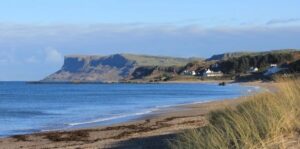
Geology: Carboniferous sedimentary rocks at the eastern end of the beach formed part of what became the Ballycastle Coalfield, which fuelled the town’s industrial rise.

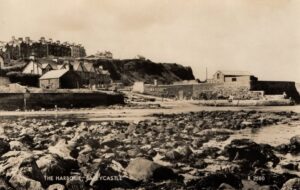
Early records show a simple fishing village with a natural landing stage at the mouth of the Margy River – Margietown.
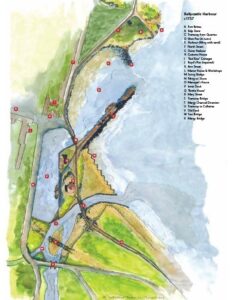
(1737–1765) Under the leadership of Colonel Hugh Boyd, the foreshore was radically reshaped into one of Ireland’s most important industrial hubs including the construction of a stone and timber harbour which, by 1744 could accommodate in excess of 60 Ships. The foreshore and surrounding area became busy with salt works, tanneries, breweries, and soap works, all fueled by the local collieries.An Inner dock was excavated to shelter large vessels of up to 150 tons (now the tennis courts) A 90-foot-high glasshouse was built near the harbour on a site known as “Glass Island” . It produced dark green bottles, fragments of which can still be found on the beach today.
After Boyd’s death in 1765, the harbour was not maintained and began to silt up with sand and by 1832, becoming unusable and eventually serving as a town dump.
In the late 19th century, a second iron pier was built to export limestone, and the town’s focus shifted from heavy industry to tourism as Victorian houses began to line the quay.