Diary of Annie McKillop (Part Three)
Back to a Nursing Career:
I reapplied for nursing to Middlesex and this time at Ashford County Hospital and I started on the 22 June 1942 and never looked back. I enjoyed it and was doing something I always wanted to do. I required a passport, so I had to get two photographs and then wait to see if it would arrive. I was looking out for the postman every day and finally Charlie Thompson (the postman) delivered this important letter. Then I required a sailing ticket’ to get on the Heysham boat; it was an exciting time for me and also very sad to go away among strangers and no idea if I would ever be back home. My packing and all done, I was ready for my journey. It was a beautiful June morning and as I looked around Upper Cloughs, I couldn’t help wondering why I was leaving this beautiful place, so peaceful. The birds were singing, hawthorn blooming, the fields all different shades of green. Hearing the rattle of carts going to the mountain to the turf, as I headed down the fields to get the bus for Belfast, I felt very sad. My cousin, James McKillop, came along to carry my case and tried to cheer me up. The bus arrived, he shook my hand and said good-bye. I boarded the bus with a huge lump in my throat and the tears pouring down my face. I went to the front seat as I didn’t want to be seen so tearful. I only got seated, when a good neighbour, John Joe O’Mullan, sat beside me and very soon I was feeling more composed. The bus arrived at Smithfield, Belfast, and then I walked down to the boat. Safely on the boat, it was time to settle down for the journey.
I think the boat journey to Heysham took nine hours, but I got a berth and slept most of the way. Arriving at Heysham it was easy as we only walked off the boat and onto the Euston Express train. The train only made stops at Rugby and Crewe and took nine hours.
The English countryside was very nice, but, when passing towns, you thought how dirty and crowded they must be. I had some food on the train and was looking forward to seeing London. I’m now in London getting off the train and seeking out the subway, hoping to arrive at Waterloo. I missed my directions and got up out of the subway station at Victoria Station. We were always warned in those days if we needed directions always ask a policeman. I approached this policeman and asked how I would get to Ashford Hospital – “Shure an begorrah, you ‘re just over there” – and takes me across the street to the bus (he stopped the whole street with one wave of his hand!). As I approached the double decker bus, there were other girls with cases and I realised they were likely going to the same hospital. The bus took me to the hospital gate (on the London Road).
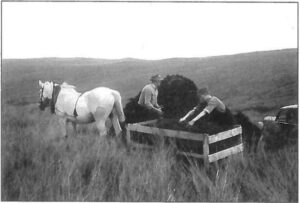
A wicker basket [kish] or box mounted on two shafts was used on rough or soft mountain ground. Wheeled carts needed hard ground. John McAuley and his father are loading turf
We were interviewed and got some food; we were then shown to our dormitory. The dormitory was a ward in the old ‘workhouse’ and the beds were spaced to allow each one a wardrobe and dressing table. There were thirty-six of us entered for four years duration, four Irish girls, three German Jews, one Scotch and the rest English.
We were called at 6.30am, dining room 7.00am. Getting up, you stripped your bed, folded your bedclothes in three over the chair and opened your window, before going to the dining room. The breakfast was porridge, then toast and poached egg and tea. The morning break was 9.15am for 15 minutes. In that time, you made your bed properly and returned to the classroom, where the Sister Tutor gave you practical nursing training and lectures on medicine and surgery. We had so many lectures from the surgeons and physicians over the next four years. We trained on the ‘Block System’ – three months in PT school, sat an entrance exam, which I passed, and went on to general training, started on the wards full-time and went back to school for a preliminary exam and lectures for eight weeks. When you passed your preliminary you got another blue stripe on your cap. We went back to school, in second year for Medical Block; and in the third year for Surgical Block; and finished our State exams in third year, but we still had to complete four years in the hospital and near the end we applied for midwifery training.
Because the war was on and near to the second front’ we were not allowed back to Ireland for three years, in case we would give secrets to the enemy (the Irish Free State was neutral).
I very soon got over my home sickness, with all these new friends to mix with. They were very jolly, good girls and, of course, none of us had any money, so we spent a lot of time going walks, talking or reading in the sitting room. There was just a small wireless in the sitting room and this German girl, Monganthol, was senior to our school, and she always seemed to get beside the wireless and put on classical music. Of course, we would all have preferred something more like ‘Workers Playtime’. I very soon got used to the routine and was very happy, especially when I passed my entrance exam at three months.
When I finished the three months trial period, I got promoted to sharing a cubicle (for two) and Sister Tutor told us we could pick who we wished to share with. I didn’t rush to pick but waited to see who everyone was picking and, to my joy, Margaret Begley asked me would I mind going with her? I was delighted, she was my first choice and we shared a room ’til we were finished. The ‘’Blackout’ was very strictly observed and all lights went off at the mains at 11.00pm in the Nurses Home.
The air raid sirens went every night and we had to fire watch one night per week. We just went on working or sleeping, as the sirens were so frequent, we would never have got to bed. There was a last desperate effort by the Germans’ ‘Luftwaffe’ in the Spring of ’45. They dropped a bomb but by good luck it missed the wards and hit the stores, ether and gas, etc, and what an explosion, that went up to the sky. I was returning from a walk and walked into the explosion; I got lifted up in the blast and thumped down to the ground again. My back was hurt but if you were able to walk you just got up. The nearby village was hit and the casualties started to pour in and, of course, all staff was called back on duty to help. That Spring the ‘Buzz Bombs’ (pilotless planes) I started. We heard that there were pilotless planes over Britain the previous night on the morning news. That evening after nine, a group of us were coming up the corridor between wards. The local ‘ack -ack’ were noisy and we saw the puffs of smoke from the guns, arched in the clear sky, and then to our amazement a plane was flying straight across the sky and was doing no ducking or diving’ to escape the guns – and then we realized this was this new war machine – suddenly the engine stopped and if you could count to three, you were clear. The next minute the explosion occurred about a ¼ mile from the hospital and hit an emergency airfield. The casualties came into the hospital; there were awful burns, so bad the relatives couldn’t identify them. The planes came over every half hour from 9.00pm – 6.30am. Then we had to get dressed and go on duty as usual, so no sleep. We got through it safely.
Then next came the rocket, ‘V’ it was called. It was a very deadly bomb but none of them were good. There were lots of invitations to the hospital for nurses to go to the army, navy or air force camp for dances and, of course, it was free and lots of tea and sandwiches. We were glad to get out a run. They would come to the hospital with the army lorries to collect us and leave us back home. We were even out to the ‘Free French’ camp’. They knew no English and we knew no French, so we just danced away (you don’t need language to dance).
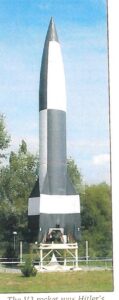
On the 6 June 1944 at 6.00am, the second front opened up and there were crowds of service men, of all colours and nationality, already crowded into our areas and all the southern counties. Once the war reached Normandy, and with lots of losses of young lives, they advanced quickly to demolish the launching pads on the French Coast and an end was in sight.
The war in Europe was soon over and my School were lucky, we were in PT for medicine and so we got three full days off. We went up to London to see the crowds and celebrations. It was so much relief; everyone was shaking hands on the streets and celebrating. The rest of the girls went to Staines. It was crowded too. The singing was coming from the pubs and the beer running down the street, as the clients had to come outside to drink it because the bars were so full. To see the blackout over and all street lighting on once more, was in itself a great delight to everyone.
In June 1945, travel to Ireland was on again. We still had to have sailing tickets to get on the boat. I made my journey back for four weeks holiday. I travelled with another nurse, Jolly from Co Down, Heysham to Belfast, and the journey was nine hours; it sailed at midnight and the train journey was nine hours (Euston Heysham) express. Jolly had a sailing ticket for 9 June and I had mine for 10 June. She got on the boat and I couldn’t because I had the wrong date. She managed to get a sailor to get me a ticket and get on the boat. That was some relief, he gave us his name and address, (Jones from Swansea) and he would always get us tickets for future travel. It was wonderful sailing up Belfast Lough – a beautiful sunny morning and to see the view over the Antrim Coast and Islandmagee – I just felt it was magic and wondered why I ever went away in the first place. I then got the Causeway bus for Cushendall and finally home.
I was surprised there were so many changes during the three years I was away. Quite a few of my neighbours were dead, some married, lots more young cousins born and some sailormen had wives from Limerick and Galway. The first few days I felt everyone had changed and when I got to my first ceilidh or dance, I renewed old friendships and met Alex and from there on, the month flew. Visiting friends and relations by day and out to dances every night. We always got our four weeks holidays in one break and all our School would leave at the same time. When I got back I had to settle to some serious study for my State final the following June. We did three months’ night duty every year and that just left nine months for revision and lectures. I was always very sad leaving home and this was no exception, but when you are part of nursing training school, you are equal ages and mould together like a family and very loyal to your own School. A few days and you are back to normal. The year passed and a large number of girls were leaving to do midwifery, and there were sad goodbyes at Christmas 1945 (first peaceful Christmas).
In June 1946 I sat and passed my State final, but I had to stay on and finish up some sick leave I had during my four years. I applied and was accepted for midwifery at Robroyston Hospital, Glasgow, to start 1 December 1946. I left at the end of October and went back to Ireland for a month before going to Robroyston. I started Robroyston, 1 December 1946; I missed my old pals of four years but got on with the job and did my twelve months training and passed my two exams and finished on 1 December 1947. You just get trained there and when finished you apply somewhere else for a job. I applied to Motherwell Maternity Hospital for a staff midwife post, explaining I would only be available after February 1948. I was called for an interview and the deputy matron saw me; I asked if there was a job available and she said yes. Come the end of the interview, she said there was something else she had to ask me, it was only a formality – what religion are you? I answered “Roman Catholic” and the whole atmosphere changed and she hummed and hawed and said Matron would let me know, but I knew I had failed for the job. The next day I got a letter to say they needed someone to take up an immediate post. I had made it very clear in my application I was waiting until February for my exam results. I got a staff midwifery post at Bellshill Maternity. It was a lovely pleasant hospital. The Matron and staff were all so good and helpful and I was very happy there. I was able to stay at my mother’s home in Hamilton and travel daily to work.
I was back in Ireland on holidays as often as I could and continued my friendship with Alex and getting an odd letter from him kept me happy. I was waiting for the bus at Joe’s Bar to go back when Hugh McSparran (RIP) came to say Cheerio. He says to me “why don’t you nurse at home?”, “I would never get a job here”, I said. “If you had a job, would you come?” I said “yes“. He sent me this form to apply to Dalriada Hospital for a midwife’s post. I sent it back and was surprised to get a letter a few weeks later to say I had to start on 1 January 1949. I took the job and that was me back to Ireland. I stayed at Ballycastle for one and a half years and then got a job in Cushendall Hospital and, as I was getting married in a year’s time, I was very pleased and nursed for many years there.

Annie married Alex McKillop in 1952; they had Alex, Anne, John and twin boys, Donal and Niall. Alex died 7 June I 992 and Annie died I December 2011.
Annie married Alex McKillop in 1952; they had Alex, Anne, John and twin boys, Donal and Niall. Alex died 7 June I 992 and Annie died I December 2011.