‘Leaving the Glens Farm of my childhood’
My childhood years passed on quickly and I was now fourteen years old and had to leave school on 29 May 1934, as my uncles and aunts had married and left home, I was now needed to work on the farm. I was very sad leaving school as I wished dearly to go on to further education but I ended my time doing two years in the seventh and eighth class. I had loved school, now it was good-bye to all that.
Now I am an adult fit for work of all kinds on the farm and I am also an adult socially. Soon, I ventured to ask to go dances, and of course I got permission to go with my aunt Sarah, as she needed company too. My first dance was in Glenaan School. Hugh McSparran was the doorkeeper and he let me in free (it was one shilling). I was very surprised when this young man asked me to dance but I said ‘Sorry, I can’t dance these dances’; they were the foxtrot, quickstep, etc. (I only learned dances from my grandfather such as polkas, reels, waltzes). I felt very shy and then my cousin, Johnnie McDonnell, got me up and – so I fell into line and quickly learned a few steps – I enjoyed the night well.
The young man who asked me to dance was now asking to see me home, but I informed him I wasn’t taking any boys home, I was just going home with Sarah. I afterwards learned some of the girls my age took boys home, so on my next outing I was open to offers. Sarah agreed to take me to the next dance in ‘Tully Barn’.
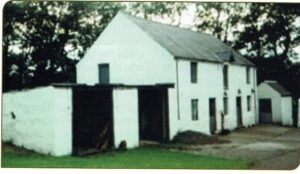
Photo courtesy of Rosemary Wheeler, née O’Rawe
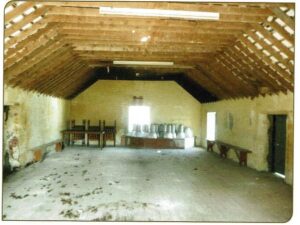
Photo courtesy of Pat McNaughton
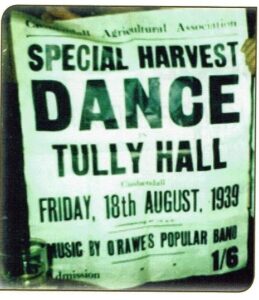
Photo courtesy of Una Goligher née O’Rawe
There were no dance halls locally apart from those in hotels, so entertainment took place in school halls or barns, hence the term ‘barn dance’. The loft or dance floor of Tully Barn was very spacious and part of the stage is still standing. Underneath was a stable and byre. The owners, the O’Rawes were themselves, gifted musicians and they provided the music. Jaimie O’ Rawe is pictured above holding a poster for the Friday Night Dance of 18 August 1939 just before the outbreak of WWII and advertising ‘O’Rawe’s Popular Band’. The dance promoted the local Cushendall Agricultural Association set up to inform farmers of the latest advances and to ensure fair prices for farming produce especially for the price of milk. The admission price would equate to about £5.00 today. (D. O’L.)
On the following Sunday night Alex Quinn, Sarah’s future husband called over to see her, and as was the custom they stood out in the car house. It was a downpour of a night but I coaxed her and at least set out for Tully. The water was running like a river on the road and soon our feet were soaking and we thoroughly soaked. We got to the barn and soon forgot we were wet at all.A good dance and we enjoyed it well. The young man who asked me to dance at Glenaan School came to ask me again, and we danced several times and eventually he enquired about seeing me home. I consented and he came all that way, two and a half miles to Cloughs in the drenching rain and then two and a half miles back, as he lived beside Tully. From that time onwards we were good friends and he later became my husband – a lot later.
After a while, Madge McNaughton and I went to all functions together and we enjoyed each other’s company so well, we never bothered with any other girls at all. We always seemed to flirt about with men and never eyed them up for marriage as most girls did. We enjoyed the company and the craic and so did they. Apart from dances, our social life was out-doors and we always attended church including all the evening ceremonies. Afterwards, we went for long walks around the shore and we often walked over to Bella Delargy and Mary Emerson’s homes. There were also concerts and bazaars. We went to see the play ‘East Lynne’2 and to Archie Macaulay’s barn for Tony Mick3 and his father ran a bazaar there and crowds came. Then we céilídhed in certain houses with maybe a gramophone to play and dance to. We went to all the barn dances about: Dan Delargy’s of Barrard, John McCurry’s, Ballyeamon School, Tully Barn, Mickey Bann’s and even up to Esherry at Willie Blaney’s and Dan Mcauley’s, Cloughs. There were field sports too, such as the Glens of Antrim Feis at the end of June, the Agricultural Show in Cushendall on the 13th July, and the Cushendall Regatta on 15 August. These were always popular days out and the Fair days and the Turkey Market4 were always good craic.
The farm work was heavy for me, and my grandmother would always caution Sarah not to put too big a burden on me, but needless to say, Sarah filled bags of potatoes till you were almost beat to carry them. It took a good burden to fill the twelve gallon pot for the feeding of pigs and as we would have to come four fields to the house, she felt it was a waste of time taking small burdens. We had to dig, gather and carry them that length, then wash them and fill the pot, get turf for a good fire to boil them to be ready for the pigs and poultry in the evening. The pot was emptied and refilled and had to be boiled again and left ready for morning. When the potato season was over, we had to gather dockens and blade kale, which was planted through the new season potato drills, and fill a bag of the outer leaves and boil a big pot of gruel (yellow meal boiled). We cut the kale blades and dockens with a knife made from a half scythe blade, put it in a wooden tub (made from a barrel cut in two) and poured the yellow gruel over it to feed the pigs.
For calves you made the same gruel but added calf meal – sometimes linseed meal to it; they were fed twice daily. The calves were all bucket-fed as the milk was needed for churning butter to sell to help to buy groceries. We would have to churn three times a week,as the milk soured very quickly. Churning was heavy, using the plunge churn, and you had to keep a rhythm going, we used a thermometer to get the milk to the right temperature.
Churning was a weekly chore on most farms, even after the advent of local creameries which bought the farmers’ milk. The churn, staff, butterpats and print as described by Annie are pictured here.
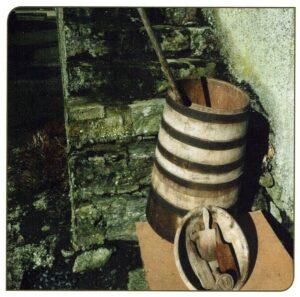
Photo courtesy of Eileen McAuley. (D. O’L.)
The most important part was to scald the churn and butter dishes and all the receptacles for collecting milk (sterilising) and while collecting the milk to stir it twice daily. The milk was always easier churned in the summer time and you would get lovely yellow butter. For taking the butter off the churn, you scalded your hands, rubbed them well with salt, rinsed and then gathered the butter and squeezed as much buttermilk as possible out of it and put it in the wooden dish. This continued until there was no butter left floating on the buttermilk. We mixed in the salt, and then took a knife and went through the butter in all directions to catch any hairs which might escape the strainer, rinsed until there was no colouring of milk in the water, drained off all the water and with the two butter spades (pats) clapped in small amounts to press all the water out. (Butter won’t keep fresh with water in it). Having done all that we made either prints which were roughly a half pound or pound squares. The print was wooden, some had a thistle design, others, roses, etc. When I was fifteen, I was a fully-fledged farmer; baking, milking, washing, ironing, cooking and lots more.
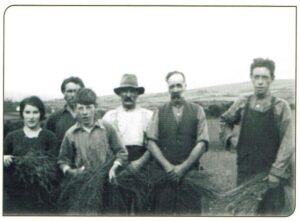
Back Row L/R: Pat McNaughton, Patrick McDonnell, Alex McNaughton (Granda), PJ McKillop Front Row: Annie, James McKillop.
Photo courtesy of Mick Quinn
The year 1935 was a very dry summer and so there was no water to fill the lint ‘dubs’. The flax was pulled and stooked, standing for 5-6 weeks before it got water. We thought the drought would destroy it, but it still scutched well and gave good yields.
Pulling flax was a backbreaking job but neighbours readily helped each other (‘murrowing’). Those who worked to farmers on a seasonal basis could earn decent money ‘pulling lint’ – generally around two shillings per stook of twelve beets (sheaves). A very good puller could pull 13-14 stooks per day earning 25 shillings approximately, at a time when the weekly wage might only be 60 shillings or £3.00. In the illustration, Annie is shown with a beet in her hand. (D. O’L.)
The year ended with severe frosts starting in mid November and lasting until Christmas Eve (six weeks). It froze every night and thawed a little each day and the roads were covered to a great depth with black ice, so too were the Cushendall streets, and people put socks over their boots to keep from falling down. The turkey market was always held on 16 December and that year the horses were not able to go down the roads, so people put the turkeys in the horse cart and pushed it themselves to the market and when the turkeys were sold, the carts remained in Cushendall till after Christmas when the frost all thawed.
In July of 1935, Uncle John’s wife, Ciss, and her two sons, James and Bob, came to visit their grandparents. There was joy and happiness in the home, but I think my grandmother would have preferred to see her son, John, coming himself.
When 1936 came there were only four of us left, my grandparents, Uncle Pat and myself. Sarah had married earlier in winter and now my grandmother was failing and so all work in the house and yard fell to me. On St Patrick’s Day I got up to go to first Mass at 8.00am. My grandfather was up and talking to me as usual, no complaints, and by the time I returned from Mass he was already away to the second Mass and went to the fair in Cushendall as usual.
Madge and I went to the fair in the evening and as it was Patrick’s Day we had permission to go to a concert and dance in the Glens of Antrim Hall. Towards the end of the concert Madge asked if we were waiting for the dance, and I was surprised when she said ‘I have a feeling I should be at home’; ‘that’s strange, I feel I should be at home too – we will go home’, (at fifteen we would have given anything to get to a dance). Home we went, up Cloughs Road and across the fields and this wailing stayed with us all the way to the house. There was a sow pigging and I called upstairs and my grandfather answered me. I left Madge to the ditch near her house and was surprised to see her father looking out for her (the same wailing was around her house all night). I came back into the house and was waiting to hear Pat, so that I could leave the sow and pigs for him to look about. I heard this very loud moan and I got the lamp and ran to the byre to see what was wrong. Pat was coming into the yard saying ‘Where the hell are you going with the lamp?’ I told him there was a cow moaning – he told me I was imagining things. As soon as I got back to the house, my grandmother who was downstairs called to me to come quick because grandfather had taken a weak turn. I asked her if he was dead. She assured me he wasn’t but I was unable to go upstairs to check until I got a mouthful of water.
Pat went up ahead of me, but my grandfather was indeed dead. The usual formalities followed, priest, doctor, etc., but my grandfather was dead. I was devastated. I still can’t find words to express my grief and loss. I suddenly had to grow up. He was my grandfather and also my father (my father died when I was fourteen months old). Every place he went, I went too. When he went for a céilídh he put me on his back and took me with him. The family said he took me to keep the ghosts away. He was inclined to be afraid of ghosts. He was a marvellous man with children. At night he taught me to dance: the straight line polka, the plain polka, the stack of barley, and he also danced a hornpipe.
It took a long time for me to get over my loss (in fact I still miss him) but what was I going to do? I couldn’t leave my grandmother alone. She reared me and took good care of me. I loved her too, but she was quiet and sensible all the time, very dignified. Pat became increasingly bossy but nobody took him seriously. I continued to work as usual until my grandmother died in January 1939. As long as she was living I had a home – now I had none.
I was just eighteen and no job, no home. What should I do? Remain a slave to my uncle on the farm in Cloughs or go out into the world and make a living for myself? I chose the latter.
I decided I always wanted to be a nurse so I applied to the West Middlesex Hospital, twelve miles from London. I was accepted for the school, commencing 23 August 1939 and duly got things ready. My aunts by this time each had several children and times were very bad in the thirties so they were unable to give me any help. I thank Mrs Arthur McAlister for all
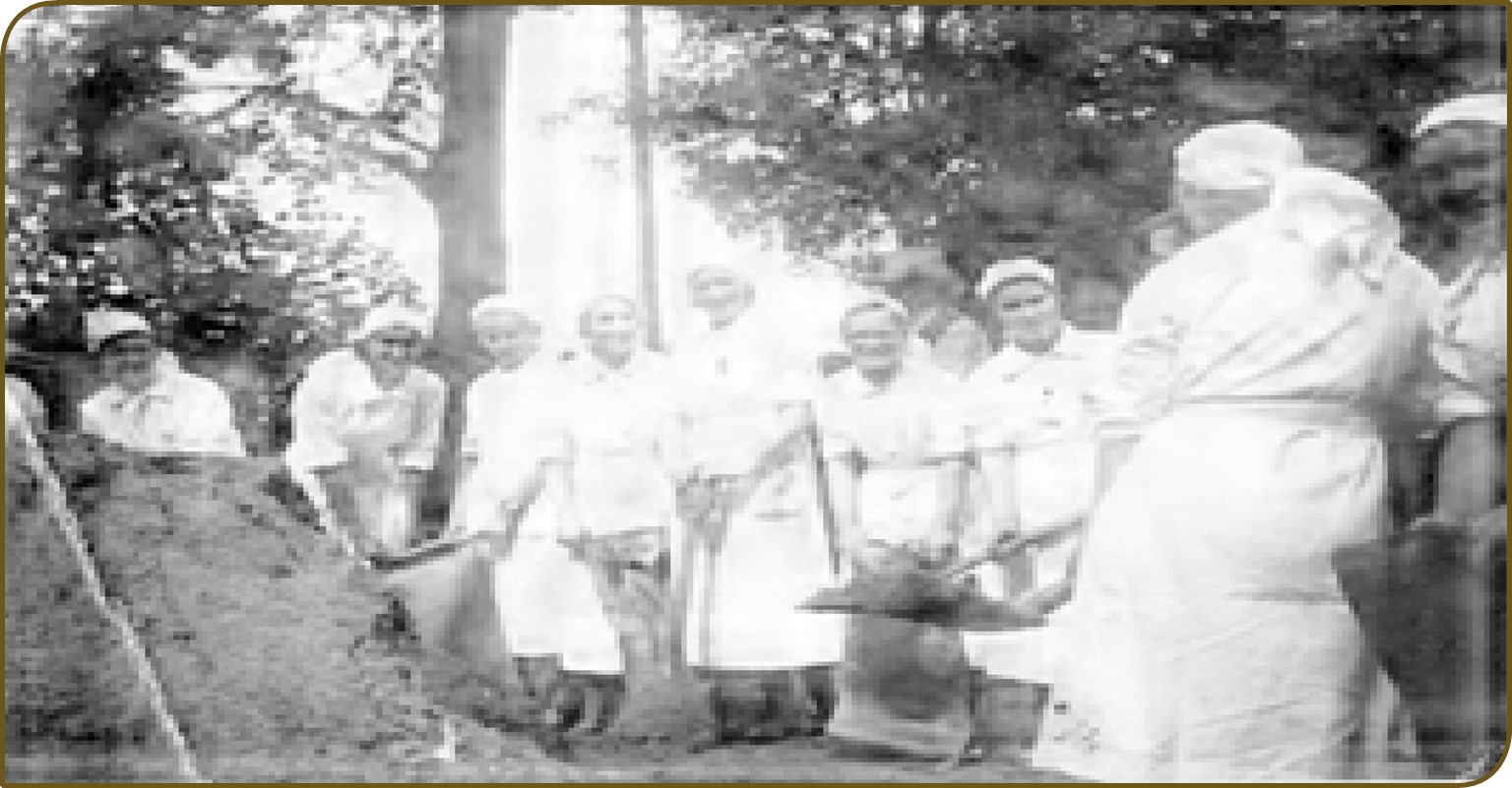
Annie Smith, extreme right, filling sandbags in West Middlesex Hospital grounds
the help she gave in getting me coats and dresses from the wholesale warehouse in Belfast to save money. I also had to have a big suitcase, so she organised all that for me, on credit. She also arranged with Lady Cushendun to meet Annie McKay and myself at Euston station. We were given a flower to wear so we could be recognised. John McKay and Annie collected me at the crossroads and we travelled together to the Heysham boat at Belfast Harbour. The crossing to Heysham went well and a ten hour train journey from Heysham to Euston in London followed. The journey was exciting and the feeling of freedom was good, but at the same time I was heartbroken leaving home and felt very homesick after I reached London.
We started in the training school with lectures and practical demonstrations. The first thing that surprised me was all the fire drill. I didn’t understand it at first, but soon I did. The following Sunday, 3rd September 1939, war was declared. The older staff were crying; they had suffered through the First World War. I had no idea what war meant, although I was a war orphan. I soon realised how serious it was when letters arrived from home, and mentioned the return of the sailors and workers to Cushendall, and that I should do the same. After three weeks I did decide to come back home, but I made it clear I was not going to slave on the farm, I was going out to work.
I started to work with Mrs Black in Delargy’s Hotel training as a cook. It is hard to imagine that in 1939 there wasn’t even an electric kettle in the kitchen although Cushendall had had electric light for a year before that. I got up at 6.30am, and had to clean down all the flues and stoves every morning before the coal range was lit; there was a second stove in the kitchen which was also lit during the busy times in summer. I was responsible for this and for scrubbing the hall and stone steps outside while the fire was lighting up, and for cooking breakfast for the staff, all before eight o’clock.
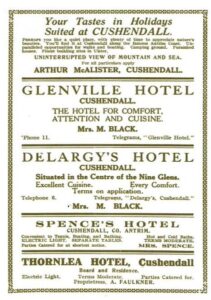
There were two large kettles on top of the stove and one must always be boiling and the fuel had to be turned in such a way that all-red coal was showing at the grate. This was necessary to do toast which was served with all teas. It was a very hot kitchen to cook in and the ventilation came from two skylights only one of which opened. We worked from 7.00 am till 10.00pm, seven days a week with one evening off per week from 6pm-10.00pm. Social life was nil. We called it ‘The Convent’! The wages were thirty-five shillings per calendar month. Mrs Black trained me during the winter months and at Easter she opened up her second hotel at Glenville for the summer season and took me with her to Glenville.
The kitchen facilities were very similar at Glenville but the clients were more up-market. Dinner in the evening, a six course meal, was at 7.00pm and the ladies wore evening wear. The food was all fresh, grown in a large garden; all the vegetables and even the flowers for the table were produced here by Jamie Delargy, Mrs Black’s brother, who was a great gardener. The milk was also produced on the farm and the sheep produced the finest lamb for the table; there were always fresh eggs and chickens. It was a beautiful place; there was even a small putting green.
I stayed there till January 1941 and then took up a post as cook in the nurses’ home in the Dalriada Hospital, Ballycastle. The wages were seven pounds ten shillings per quarter (approximately £25.00 per week currently). There were four nurses and two midwives, four on day duty and two on nights. The cooker in the kitchen was a mini ‘Esse’ with a very small cooking plate and a flue that drew badly in certain weather conditions. I had to cook all the meals, and shop for each of the staff with a different grocer or butcher because the rationing was in force. A cooked dinner was expected each evening but each nurse chose their own menu; one requested soup, another stew, the remainder requested a fry and there was never enough room on the small ‘Esse’! In addition to cooking I had to clean the residential accommodation and there was no pleasing of them, so I stayed just a year. My mind was made up. I reapplied for nursing to Middlesex and this time at Ashford County Hospital. I started on 22 June 1942 and I never looked back. I enjoyed it and I was finally doing something I always wanted to do.

Former Nurses’ Home at Dalriada Hospital
Loved this, my daddy would have worked in blacks hotel at the same time as this lady.
It was fascinating to read this beautifully written account and humbling to realise how very hard this competent lady had to work. As usual I was interested to read the references to my pun family.
This lady was my Aunt i new she was a nurse but i didnt know about the half of Annies journey, thank u for printing Annies journey im sorry to hear she has passed away, what a brave brave, n inspiring woman regards to her familly