The social position of the practising artist keeps changing over the centuries. Certainly in the eighteenth century there were noticeable differences from the situation to which we are accustomed today. Art is now and was then a profession, and every profession has its aristocracy, bourgeoisie and proletariat. Consider the legal profession: its aristocracy are the Law Lords, QCs and top barristers; solicitors form its middle classes; and finally there is the amorphous poorly-paid legal proletariat of clerks, law writers and office staff who support the profession from below. Police and prison officers might be added to this group. Or if we look at the medical profession, its aristocracy are the Harley Street specialists; the GPs make up the middle class, and the medical proletariat consists of junior housemen, paramedics, ambulance drivers, pharmacists, laboratory technicians, secretaries and, of course, nurses and ward cleaners.
In the eighteenth century the profession of art worked something like this. At the top (in England) were the Royal Academicians, the fashionable artists who could expect lucrative commissions from the Royalty and Nobility. They could afford to live in some style and to move among the great and good of the realm with at least a semblance of equal social standing. The proletariat of the artistic profession were the apprentices or art students (for the most part very poor) studio assistants and the related trades: colourmen, framemakers, gilders and reproductive engravers. Somewhere in the middle we find the drawing masters.
Most of the major figures in topographical watercolour painting in Britain and Ireland in the eighteenth and early nineteenth centuries were obliged through economic necessity to augment their income by working as drawing masters. Their clients came mainly from the aristocratic, moneyed or leisured classes. George III took drawing lessons and became an accomplished draughtsman and amateur architect. Some artists, such as Alexander Cozens at Eton, found permanent employment as drawing masters in the Public Schools. Others worked in similar positions in the Military and Naval Academies, where draughtsmanship was considered necessary for officers in recording terrain. John Baptist Malchair set up a private practice as a drawing master in Oxford, where he taught the wealthier undergraduates. Other artists operated on a peripatetic basis, moving around the country giving private lessons in the houses of the rich, where they would be treated on the same level as tutors or domestic servants. One such drawing master was John James Barralet (cl747—1815).
Of Dublin Huguenot stock, John James Barralet was trained in the Dublin Society’s drawing school under Robert West and James Mannin, and first set himself up as a drawing master in Dublin. Barralet’s father appears to have been a recent emigre from France, and Barralet himself spoke French with “volatility” throughout his life. His younger brother, John Melchior Barralet (cl750—cl787), also became a topographical artist.
John James Barralet had moved to London by 1766, and opened a drawing school in James’s Street, Golden Square, in 1773. In 1777 he opened another in St. Alban’s Street, Pall Mall. During this decade, 1770—80, Barralet also exhibited topographical landscapes and Shakespearean scenes in London at the Royal Academy and the Society of Artists, of which he was elected a Fellow and Director in 1777 [1]. Moreover, he seems to have pioneered the production of small whole-length watercolour portraits, along with Francis Wheatley, Thomas Rowlandson and Robert Dighton.
Barralet returned to Dublin in 1779, and was recommended by his old teacher James Mannin as his substitute and eventual successor in the Dublin Society’s school of ornament-drawing. Here Barralet taught for three months, and was popular with the students. He also won himself two influential patrons from among the Society’s vice-Presidents — John Foster and Edmund Sexton Pery — both of whom filled the office of Speaker of the Irish House of Commons during the next decade. Unfortunately, on Mannin’s death the teaching post was given to another candidate, William Waldron, who had the support of the Duke of Leinster. Despite a student protest in his favour, and the subsequent setting up of a committee of enquiry, Barralet failed to secure the post and was forced to seek what employment he could find.
For a time he accompanied another Dublin Huguenot draughtsman, Gabriel Beranger, on tours in Counties Wicklow and Wexford, making sketches of antiquities for Captain Francis Grose’s “The Antiquities of Ireland” which was not published until 1791—95.
In 1782 he was working as a scene painter at the Crow Street Theatre in Dublin. Emigrating to America in 1794 in the forlorn hope of finding more profitable work, Barralet settled in Philadelphia. Redgrave [2] states: “though at first a great beau,, he is said to have fallen into slovenly habits”. He was married twice. Though he took an active part in the limited artistic community in early Federal America, Barralet never prospered, and was much beset with yellow fever, poverty and debt. He never returned to Ireland, and died in Philadelphia in 1815.
In 1982 the Ulster Museum bought a series of eight very interesting drawings of Glenarm and its vicinity, dating from the 1780s and 1790s. When bought, the drawings were in a contemporary paper folder inscribed: “Views of — from — or near Glenarm — in 1787—88—89. Mostly by Mr. Barrales [sic] artist and drawing master”.
I personally feel that they are not all by the same hand, and that this is confirmed by the fact that two of the dated drawings are dated 1796, the year after Barralet emigrated to Philadelphia. If the inscription on the folder can be trusted, and the Barralet drawings of Glenarm date from the late 1780s, they can be seen as a distinct improvement on earlier dated drawings by him.
A View of Lucan House, Co. Dublin, dated 1782 (Yale Centre for British Art), is a small finicky drawing in blues and browns, similar in technique to Sampson Toogood Roche. Two views in,pen and grey wash of Ledbury Church and Village, Herefordshire and Landscape with Ledbury Church spire (also Yale Centre for British Art) are much weaker than the Glenarm drawings and would seem to be earlier. The high quality of five of the Glenarm group is not matched by the three other drawings in this group, which I take to be the work of one or more of Barralet’s pupils, possibly members of the Antrim family, done after Barralet’s departure to America. They contain stylistic similarities to Barralet’s own work, particularly in the formula used for leaves and foliage. But the series provides ample evidence that Barralet worked at Glenarm during his perambulations as a drawing master. Four of the drawings, which I assume to be entirely the work of Barralet, are of such superior quality that they contradict Iolo William’s dismissal of him as “an inept and heavy handed, if ambitious artist”. [3].
Barralet would have visited Glenarm towards the end of the short life of Randal McDonnell, the Sixth Earl and Second Marquess of Antrim (1749—91), whose portrait in Volunteer uniform by the Belfast painter Joseph Wilson still hangs at Glenarm Castle. Inordinately proud of the lineage of the McDonnell Clan and its connection with the Royal Family of Scotland, this Earl petitioned George III for the restitution of the forfeited title of Marquess, which the King granted him in 1789. In spite of his thoroughly Gaelic ancestry, he tried to be a typical example of the Anglo-Irish ascendancy, even to the point of being a leading Freemason in both Ireland and England. He was well-educated and widely travelled, and possessed a taste for the arts. As well as his ancestral seat at Glenarm, he owned town houses at 33 Merrion Square, Dublin, and in Hanover Square, London. It is likely that Barralet was introduced to him in Dublin, where the Marquess was a regular attender at debates in the Irish House of Lords, but was never really active in politics. He died in 1791 at the early age of forty-two, and, having no male issue, was succeeded by his eldest daughter, Letitia, as Countess of Antrim in her own right.
I have divided the group of eight drawings into three sub-groups by my own analysis of the technique and dating, and have numbered them accordingly for this article. The Ulster Museum reference numbers would be only confusing in this context, but I have retained them in brackets for thoroughness.
(1)The first group consists of four quite large drawings in washes of sepia, a rich brown pigment obtained from the ink-bags of cuttlefish, and frequently used in the eighteenth century for monochrome drawings. Though none of these are dated, I considered these four to be definitely by the same hand, and I think it reasonable to assume that they were executed by John James Barralet at Glenarm sometime between 1787 and 1789, when employed as a private drawing master by the McDonnell family at Glenarm Castle. There is, incidentally, an engraving of Glenarm after Barralet, dated June 1st 1793, in Thomas Milton’s Views of Seats in Ireland, published in London between 1783 and 1793 [4]. Presumably it was the commission of this drawing which brought him in the first place to Glenarm.
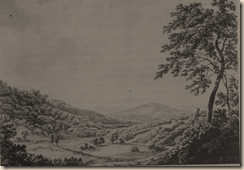
(i):UM 2598 View in Glenarm Deer Park.
 .
.
GLENARM DEER PARK J.J BARRALET 2598
Sepia over pencil on white laid paper, watermark “J. Whatman” 37.5 x 52 cm. Inscribed on verso “View in Glenarm Deer Park/ by Baroles (sic)”.
Glenarm is the only one of the nine Glens of Antrim which is completely privately owned, and in it is situated the deer park which provided a celebrated supply of venison. This is an assured piece of landscape drawing by Barralet. Notice the use of repoussoirs – pieces of foliage in the two bottom foreground corners – to suggest depth. Draughtsmen of this period used indiviudual conventions for leaves and foliage. The smaill upward curving commas or flicks of paint, seen particularly in the tree on the right, show Barralet’s characteristic calligraphy.
(ii):UM 2602 Marchioness of Antrim’s Cottage, Glenarm Deer Park.
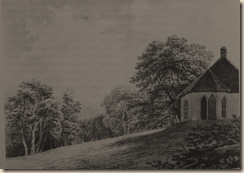
MARCHIONESS OF ANTRIM’S COTTAGE: PUPIL OF BARRALET? 2602
Sepia wash on white laid paper, watermark “Crowned Lily” 36.2 x 50.8 cm. Inscribed on verso: “Marchioness of Antrim’s Cottage/Glenarm Deer Park”. The Marquessate of Antrim became extict on the death of Randa, Sixth Earl and Second Marquess, on 29 July 1791. He had married, in 1774, Letitia, daughter of the First Viscount Mountmorris, who was already the widow of the Honourable Arthur Trevor. The widowed Marchioness lived on until 1801 (G.E.C Complete Peerage). She appears to have had this garden retreat built in the form of a picturesque gothick thatched “cottage ornee”
(iii): UM2600 Glenarm River and Bridge, looking towards the sea.
![image[42]](http://www.antrimhistory.net/wp-content/uploads/image42.png "image[42]")
GLENARM RIVER AND BRIDGE J. J. BARRALET 2600
Sepia wash on white laid paper. 37.2 x 49.8 cm. This fine drawing shows the seventeenth century two-arched private bridge leading to the Castle, before the building of the Barbican Gate in the 1820s. Barralet was at Glenarm thirty years before the baronialisation of the Castle and grounds by William Vitruvius Morrison. It is also evident that the three-arched bridge which now carries the coast road has not yet been built.
(iv): UM 2599 Glenarm Harbour.
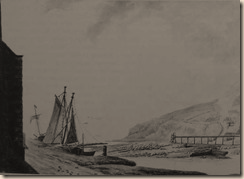
GLENARM HARBOUR J. J. BARRALET 2599
Sepia wash on white laid paper, watermark “Crowned Lily”. 37.5 x 52.7 cms/14% x 20%”. Inscribed on verso: “By Barralet”. This shows the corner of Glenarm Church on the left, one of the islands known as “The Maidens” on the horizon, and a working lime-kiln on the hillside on the right. This hillside has now almost been quarried away by lime workings, much to the disfigurement of the village and the pollution of the atmosphere. The present coast road was not built until the 1830s.
(2)The second group consists of only one sepia wash drawing which is dated on the back “February 2nd. 1794”. This may be eithec.by Barralet or by a pupil, but I think the quality is consistent with Barralet’s own work. This would suggest that he came to teach at Glenarm more than once, and possibly spent part of several summers here.
(v): UM 2603 Garron Point

GARRON POINT (BARRALET OR PUPIL?) 2603
North East View of Garron Point 1794. Sepia wash over pencil on white wove paper. 33.6 x 48.3 cms/13% x 19”. Inscribed on verso: “North East View of Garron Point in the County of Antrim. Belvoir February 2nd 1794”. Barralet is documented as attending a meeting of artists in Philadelphia on 29 December 1794, so it is possible that this is one of his last dated Irish drawings. The February date does not necessarily imply that this drawing was made on the spot at that time. Indeed, it is more likely that this was made indoors on that date, not necessarily at Glenarm, working from a much slighter sketch made on the spot some time earlier. The Knight of Glin (verbally 1983) suggested that since Barralet did some work for the Duke of Rutland when he was Lord Lieutenant of Ireland, the name “Belvoir” might refer to his Castle in Leicestershire rather than to Belvoir House in Belfast.
Garron Point is a noteworthy example of a “slipped sill”, and the steeply sloping line of division between the underlying cretaceous chalk and the overlying volcanic tertiary basalt lava is clearly shown towards the upper right. This drawing shows the old coast road — the Foran Path — descending steeply on the north side of Garron Point, which in the 18th century was a formidable hazard for coaches travelling on the Antrim Coast. The old road went over the headlands. In 1801, Francis Turnly of Drumnasole near Garron Point bought the village of Cushendall, but continued to live at Drumnasole. In 1822, to ease his daily journey over Garron Point, he cut a road —Turnly’s Road — through the chalk to avoid the steep Foran Path. The Ulster Museum has some interesting watercolours painted at the same spot by Andrew Nicholl in 1828 [5]. Later, in 1833, William Bald built the present coast road as a military road to keep the lawless Glensmen under control. This road rounds Garron Point at sea level, built on horizontal arches. Later still, after Garron Tower was built by the Marchioness of Londonderry in 1848, the Foran Path was closed by building a wall across it. Fuaran is Irish for “spring”. The freshwater spring which rises at the foot of the Foran Path flows straight to the sea and is known as Ireland’s shortest river.
(3)The third and final group consists of three drawings, two of which are dated 1796, that is, after Barralet had gone to America. One is drawn in sepia wash, the others are in grey washes with added tints in watercolour. One is unfinished. Though extremely interesting topographically, they are not of the same standard as the drawings described above. I believe the three of them to be by the same hand, that of one Barralet’s pupils at Glenarm.
(vi): UM 2601 View in Home Park, Glenarm. (1796)
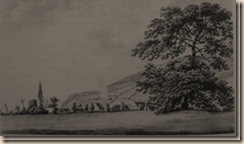
HOME PARK, GLENARM (BARRALET PUPIL?) 2601
Sepia wash on white laid paper, watermark “J. Whatman”. 31.3 x 50.2 cms/12% x 19%” Inscribed on verso: “View/Home Park Glenarm/1796”. The spire of Glenarm Church can be seen on the left, and the smoking lime-kiln in the distance, painted from a spot close to the Castle.
(7): UM2605 Glenarm Church (1796)
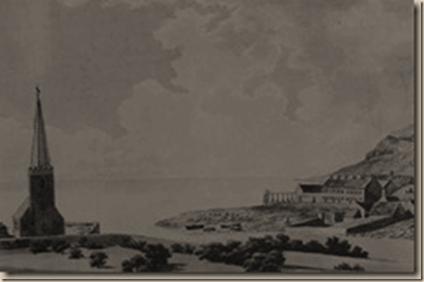
GLENARM CHURCH 1796 (BARRALET PUPIL?) 2605
Watercolour over grey wash on white laid paper, watermark “J. Whatman”.34.3 x 52.7 cm/13‘/2 x 20%”. Inscribed on verso: “Church- Glenarm 1796”. This drawing is clearly unfinished, as a boat and a pole are only sketched in in pencil. The little Church of Ireland which stands at Glenarm Harbour was built by Earl Randle’s father, Alexander McDonnell, Fifth Earl of Antrim, in 1763, on the site of the medieval Franciscan Friary. The spire is similar to that built in Ballycastle by the landowner Hugh Boyd. The boundary wall of the Castle grounds can be seen, as well as some houses and enclosures.
(viii) UM 2604 Presbyterian Meeting House, Glenarm
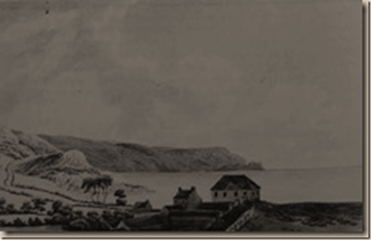
PRESBYTERIAN MEETING HOUSE, GLENARM (BARRALET PUPIL?)2604
Watercolour over grey wash on white laid paper, watermark “Crowned Lily”. 29.8 x 48.8 cms/ll3/4 x 19%” Inscribed on verso: “Presbyterian Meeting House/Glenarm Shore — Garron Point/in the distance”. The Presbyterian Meeting House was built in 1762, and here is seen almost isolated. The old coast road is shown climbing over Glenarm Point to descend into Carnlough on the other side. In the distance is seen the distinctive outline of Garron Point with its slipped sills at the end, over which the old coast road ran on its way to Cushendall.
FOOTNOTES:
1: Algernon Graves: The Society of Artists and the Free Society London 1907, p 22. Kingsmead Reprints, Bath 1970.
2: Samuel Redgrave: A Dictionary of Artists of the English School London 1878; Kingsmead Reprints, Bath 1970. See also Robert L. Raley: John James Barralet in Dublin and Philadelphia Irish Arts Review, vol. 2, no. 3, Autumn 1985, p. 19.
3: Iolo Aneurin Williams: Early English Watercolours and some cognate drawings by artists bom not later than 1785 London, The Connoisseur, 1952.
4:Thomas Milton: A collection of select views from the different seats of the nobility and gentry in the kingdom of Ireland, engraved by T. Milton from original drawings by the best artists London 1783—93. This book contains 24 line engravings after J. J. Barralet, Francis Wheatley, William Ashford, William Pars and Thomas Roberts. Barralet drew the views of Phoenix Lodge, Co. Dublin, Leinster-House, Dublin, Lucan House, Co. Dublin. The Dargie, Co. Wicklow 1783, Florence-Court, Co. Fermanagh 1786, Tullymore-Park, Co. Down 1787 and Glenarm. Co. Antrim 1793.
5:See Andrew Nicholl’s Views of the Antrim Coast in 1828. published by the Glens of Antrim Historical Society in 1982, with introduction by MartynAnglesea and notes on the plates by members of the Society.