The speech of the Glens of Antrim has been shaped as much by historical and political factors as it has been by linguistic ones. I feel that it is therefore important to begin my account of the dialect by outlining the relationship between its unique linguistic characteristics and the external history of the Region as a whole.
The dialects of English which are spoken in the North of Ireland today are reflexes of: first of all—the language spoken by the English and Scottish colonists who planted the Province in the late sixteenth and early seventeenth Centuries; and secondly — the Irish language of the indigenous population. Planters from the South West of Scotland predominated in the North and East while English settlers from the North West Midlands and the South West of England colonised much of the remainder of Ulster, forcing the native Gael to the far West and South.
Three Centuries later, these settlement patterns remain more or less intact, and this is reflected in the fact that the speech of this part of Ireland — generally termed Northern Hiberno-English — may be divided into three distinct dialects. Thus as you can see from the Map on page below: these are:
South Ulster English (Fermanagh, Monaghan, Armagh, N. Leitrim, N. Cavan & N. Louth) Mid-Ulster English (Down, N. & S. Donegal, S. Derry, Tyrone, N.Armagh, N.Fermanagh, N.Monaghan) and Ulster Scots (N. Antrim, E. Donegal, Ards Peninsula).
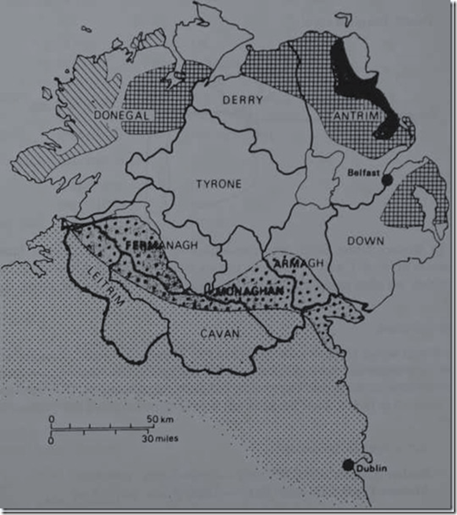
Additionally: Gaeltacht (Irish-speaking area) (N. & W. Donegal), Conservative Ulster Scots (Glens’ Speech) : (N.E Antrim)
(Adapted from Harris, 1984).
All of these varieties are influenced by interference from the grammar, pronunciation and vocabulary of Irish. They are therefore distinguished primarily by the amounts of Scottish as opposed to English features which they retain. Thus Ulster Scots has the highest proportion of Scottish characteristics; Mid- Ulster English contains a mixture of Scots and English and South Ulster English has little or no Scots.
Leaving Mid-Ulster English and South-Ulster English aside then, the speech of the Glens of Antrim as we have seen belongs to the Ulster Scots variety. As such we can expect it to consist of a mixture of archaic and seventeenth century Scots features along with other characteristics which are essentially Gaelic in origin.
Research has shown that the pronunciation, vocabulary and grammar of the dialect are affected by a combination of these linguistic forces. The phonological system of Irish does not contain the English sounds ‘d’ and‘t’ which are formed in the mouth, as you can see in the diagram, by placing the tip of the tongue against what is known as the Alveolar Ridge.
PART A
1: PHONOLOGY
a. Gaelic Influence: –
(i) Alveolar Diagram /d,t/
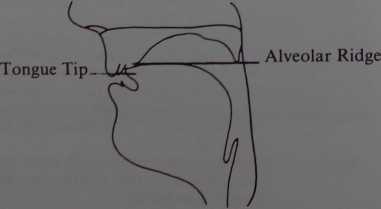
In the same way that it is difficult for an English speaker to mimic the type of French ‘r’ sound found in words like creche or bureau which have actually been borrowed into English as creche or bureau with a typically English ‘r’; the first Northern-Hiberno English speakers failed to reproduce English alveolar ‘t’ and ‘d’ exactly, replacing them instead with the closest Irish sounds. These were articulated by placing the tip of the tongue — not on the alveolar ridge — but further forward at the back of the front teeth — giving what are known as Dental ‘d’ and ‘t’.
ii. Dental Diagram /d,t/
Tongue Tip 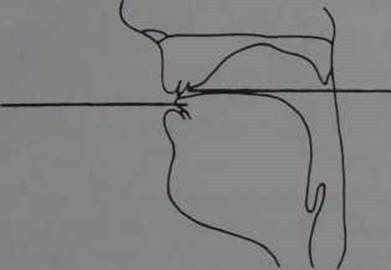 Back of Teeth
In Modern Ulster Scots, this Irish-influenced feature is most clearly heard in sequences of‘d’ or‘t’ and ‘r’, so as you can see Standard English Alveolars in ‘batter’ and ‘sister’ are often realised in Ulster Scots with a dental sound, (water, matter, butter etc.)
b.Scots Influence.
Words which are spelt with ‘gh’ in Modern English like ‘night’, ‘thought’ and so on were pronounced quite differently in Older English. The Anglo Saxon forms of these words is shown below. The spelling is slightly different and the ‘h’ in the middle is not silent. It is in fact what linguists call a velar fricative giving the pronunciation ‘nixt’.
b. Scots/Archaic Influences:
i. Modern English ‘night’: Received Pronunciation ’nait’: Anglo-Saxon: ‘niht’/’nixt’
Modern English ‘thought’: Received Pronunciation ‘8o:t’ Anglo-Saxon: ‘poht’/’8oxt’
ii. ‘Haughey’: Received Pronunciation ‘ho:hi’ & ‘ho:ki’
Ulster Scots: ‘ho:xe’
Scots, since it is one of the most conservative of all English dialects, retained this antiquated,consonantal pronunciation of‘h’ for quite some time and while most Scots nowadays find that ‘It’s a braw, brixt, munlixt, nixt the nixt’ is rather a mouthful, their seventeenth century ancestors did not! As a result, there are many Ulster Scots speakers who still use this sound. The phenomenon is especially apparent in the pronunciation of personal names and certain dialectal words.
This archaic feature which Ulster speakers inherited from their contact with Scots has been lost in much of the North and I would suggest that the frequency of its occurrence in the Glens is a result of the geographical isolation of the community.
2: VOCABULARY
Moving on then to the kind of vocabulary which is found in this region, we see again the same dichotomy between words which originate in Gaelic and those which the Scottish colonists brought with them from the mainland.
a. Gaelic Influence:
IRISH ULSTER-SCOTS
‘but’ ach och/ach
‘lake’ loch lough
‘a handful’ lo`ch lock(of pennies)
‘silence’ tost (hold your) whisht
‘unkempt’ tri`na-che`ile through-other
b. Scots/Archaic Influence:
ARCHAIC ULSTER-SCOTS
‘child’ bearn (Old English) bairn
‘small flat fish’ flynra (Old Norse) flounder
‘cry out’ gre`tan (Old English) greet
‘a few’ hwene (instr. case of hwone)(Old English) wheen
‘balance/weight’ waeg (Old English) wee (small) *
*(now gen. N.H. English)
3: GRAMMAR
a. GAELIC — Tense/Aspect System
As a conservative variety of Northern Hiberno-English, Glens’ Speech avoids the Standard English Perfect e.g. preferring constructions which follow the Word-Order patterns of Irish i.e. allowing the object to precede the verb.
a: Gaelic influence: —
i: Tense/ Aspect System
STANDARD ENGLISH
“I have done my work”
Subject Auxiliary Verb Main Verb Object
ULSTER-SCOTS
“I have my work done”
Subject Auxiliary Verb Object Main Verb
IRISH
“Ta mo chuid oibre deanta agam”
Auxiliary Verb Object Main Verb Subject
a: Gaelic influence: —
(ii) Prepositional Usage
STANDARD ENGLISH
She was sick (and I had to look after her)
Subject Verb Object
ULSTER SCOTS
She was sick – on – me
Subject Verb Indirect Object
IRISH
Bhi si tinne – orm
Verb Subject Indirect Object
(NB. In STANDARD ENGLISH: ‘She was sick on me’ means literally ’on my person’.)
Prepositional Usage
The semantic fields of prepositions vary widely from language to language — and even between various stages of the same language — the Old English equivalent of the modern proposition ‘with’ for example could actually mean ‘against’ in certain contexts. Thus one often finds that the range of meanings associated with certain English propositions is extended in Northern Hiberno-English under the influence of Gaelic. This is the case with the senses which are attached to the preposition ‘on’ in Glens’ Speech which have been expanded to include what is generally known in the literature as the DATIVE OF DISADVANTAGE.
b. SCOTS/ARCHAIC — ‘For-to’ Complementiser to Express Purpose
In Present Day English the complementiser ‘for’ can introduce a clause which has an overt subject within it: i.e. — ‘I left the parcel for Mary to open later’; where ‘Mary’ is the overt subject of the second clause.
In Earlier English, however, ‘for’ could act as a complementiser to express purpose even when there is no overt subject in the second clause. Thus in Chaucer’s Miller’s Tale which is written in the late Middle English of the Fourteenth century we find the line ‘This Nicholas was risen for to pisse’ — which hardly needs translating and contains, as you can see no overt subject in the second clause.
This archaic construction is preserved in Ulster Scots, so that sentences like the following are relatively common.
b. Scots/Archaic Influence: —
i. ‘For-to’ Complementiser to Express Purpose
STANDARD ENGLISH
I left the parcel for Mary to open later
Complementiser Subject Infinitive
MIDDLE ENGLISH
This Nicholas was risen for ^ to pisse
Complementiser Subject
(Chaucer’s ‘The Miller’s Tale)
ULSTER SCOTS 1.
He went up the street for ^ to buy a paper
Complementiser Subject
(Harris, 1984)
ULSTER SCOTS 2.
She called him over for ^ to make the others jealous
Complementiser Subject
— Negation
Ulster Scots negation generally follows the usual English pattern with some exceptions—most notably the well-documented fact that the English negative particle ‘not’ is frequently replaced by the Scots form ‘no’. Consequently, Glens’ Speech exhibits structures like those illustrated.
ii. Negation
STANDARD ENGLISH ‘Can’t you do it?’ ‘I won’t come back here again’
UlSTER SCOTS ‘Can’ you no do it? ‘I’ll no come back here again’
Adams, G.B. ‘Introduction to the study of Ulster dialects’, Proceedings of the Royal Irish Academy, C,Vol. 52, no. 1 (1948) pp. 11—24.
‘Phonology of the Antrim dialect I, Historical introduction with special reference to the problem of vowel length’, P.R.I.A. C, Vol. 57, no. 3 (1956a) pp. 69—152.
‘Patterns of word distribution’, Ulster Folklife, Vol. 2, (1956) pp. 6—13.
‘A register of phonology research on Ulster dialects’, Ulster Dialects: An Introductory Symposium, G. B. Aams (ed.), (Ulster Folk and Transport Museum: 1964 pp. 193—201).
‘Ulster dialect origins’, Ulster Folklife, Vol. 17 (1971) pp. 99 — 102.
‘Some Ulster words describing personal and animals’, Ulster Folklife, Vol. 24 (1978) pp. 69—82.
‘The voiceless velar fricative in Northern Hiberno-English’, Aspects of English Dialects in Ireland, M. V. Barry (ed.), (Institute of Irish Studies, Q.U.B., 1981 pp. 5—17.
Corrigan, K. P. ‘Northern Hiberno-English: the state of the art’, Irish University Review, Vol. 20, no. 1 (1990) pp. 91—119.
Gregg, R. J. ‘Notes on the phonology of a County Antrim Scotch-Irish dialect I’, Orbis,Vol. 7 (1958) pp. 392—406.
‘Phonology of the Antrim dialect II, Historical phonology’, Orbis, Vol. 8 (1959) pp. 400—424.
‘The Scotch-Irish dialect boundaries in Ulster’, Patterns in the Folk Speech of the British Isles, M. F. Wakelin (ed.) (London: Athlone Press: 1972 pp. 109—39).
‘The feature ‘dentality’ in Ulster Scots and its role as a sociolinguistic maker’, Paper read at the L.A.G.B./I.A.A.L. Conference, Q.U.B., Spring 1989.
Harris, J. ‘English in the North of Ireland’, Language in the British Isles, P. Trudgill (ed.) (Cambridge: C.U.P.: 1984 pp. 115—134.
Harris, J. ‘Syntactic variation and dialect divergence’, Journal of Linguistics, Vol. 20 (1984) pp. 303—328.
Harris, J. & J. Kaye. ‘Getting your teeth into coronals: the Hiberno-English evidence’, Paper read at the L.A.G.B./I.A.A.L. Conference, Q.U.B., Spring 1989.
Harris, J. Phonological Variation and Change: Studies in Hiberno-English (Cambridge: C.U.P.: 1985).
Hughes, A. & P. Trudgill. English Accents and Dialects (London: Edward Arnold: 1988).
Lass, R. The Shape of English (London: J. M. Dent: 1987-esp Ch. 5).
Logan, J. Ulster in the X-rays (London: A. H. Stockwell: 1923-esp. pp. 78—82).
Murphy, M. J. County Antrim Manuscripts (U.C.D. Roinn Bhealoideas Eireann: 1951—1976).
OMaolain, S. ‘A phoneme cluster in Irish-English’, Paper read at the L.A.G.B./ I.A.A.L. Conference, Q.U.B., Spring 1989.
O’Neill, M. (pseud, for Mrs. Nesta Higginson) ‘the Glens and their speech’, Blackwood’s Magazine (Edinburgh: 1893: pp. 367—377).
Patterson, D. The Provincialisms of Belfast and Surrounding Districts Pointed Out and Corrected (Belfast: n.p.: printed Alexander Mayne: 1860).
Naw ill naw.