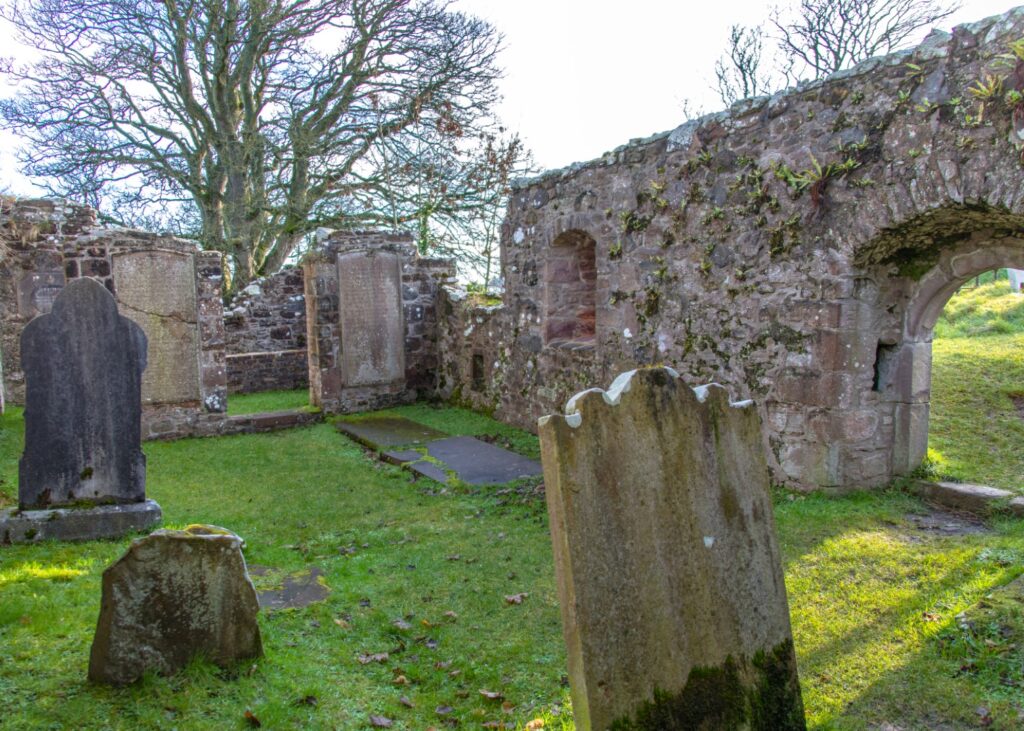
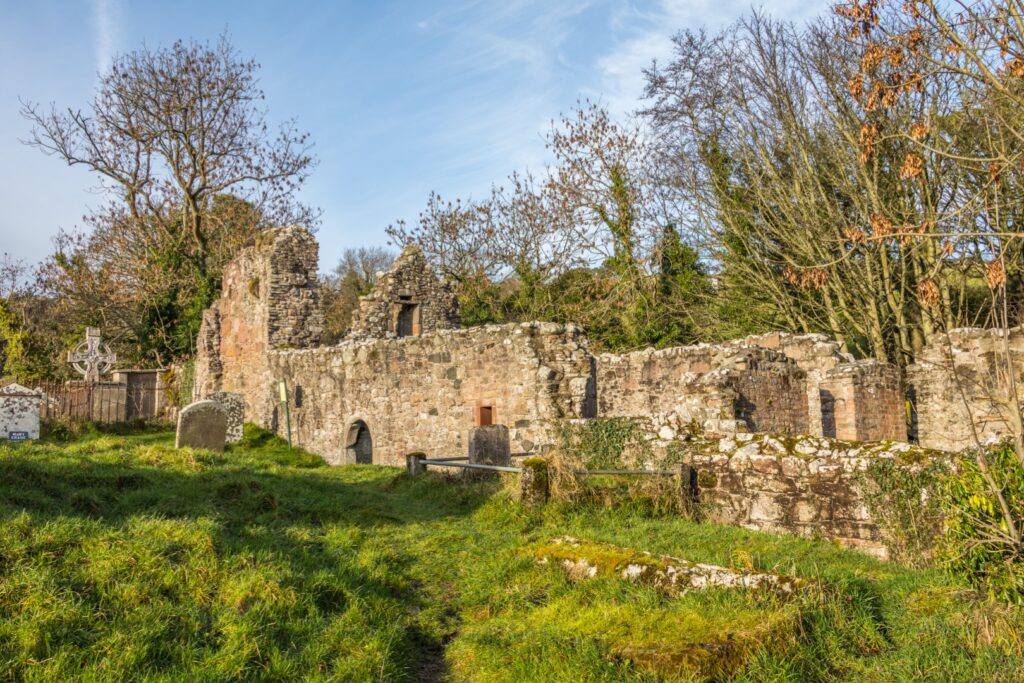
Possibly an early Franciscan Friary but it probably pre-dates the earliest Franciscan foundations (i.e 13th century). Included in the ‘Taxation of Pope Nicholas’ (1291-92) hence parish worship; likely abandoned at Dissolution of the Monasteries (1536-40). Repaired for Church of Ireland worship and three generations of McArthur family served as curates there for 100 years (1696-1796) they would often preach in the Irish language. Meanwhile the absentee rector collected the tithes – a nice income for no work. The Church (but not the graveyard) has been abandoned since 1800 but the ruins and headstones have lots of historical interest.
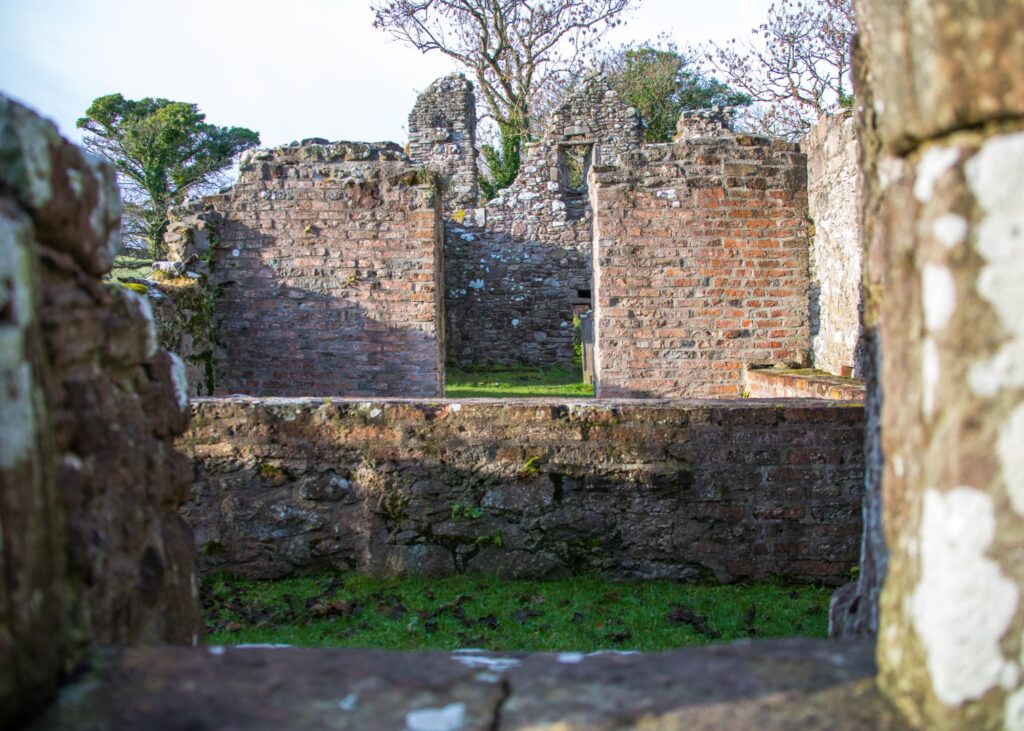
The main body of the ruins is now occupied by graves and while all graves tell a story, some graves towards the east end are of exceptional interest, seamen who perished, military of high rank, men who occupied high office, the McArthur curates and all with a strong connection to the Glens. The large room at the west end was possibly a sacristy in which the sacred vessels, vestments and church furniture were stored but its size would also seem to offer other uses. The upstairs apartment may have been the residential quarters of priests or monks.
Outside the ruin two headstones are of special interest and even a little mystery. On entering the graveyard immediately to your left, is a holestone shaped like a Celtic cross. Said to have been brought from Scotland by the McDonnells it ended up on a McDonnell farm in Lignamonagh (Glenravel) and is recorded there in the OS Memoirs for Dunaghy (1835). Ligamonagh and Carrycowan townlands were once part of McDonnell lands. Apparently the Parish Priest of the time, Fr Nicholas McCrickard, saw an animal tied to it and he had it moved back to Layde. Some accounts credit Monsignor O’Laverty for its return to Layde having seen it while recording information for his history of Down and Connor. He would have been very aware of its existence from the OS Memoirs. It is placed on a later base which is engraved ‘LIGNAMONAGH CROSS NANAGHAN’ (cros na nAghan) and marks the grave of a Frank McDonnell (d.1861) and presumably he is the Francis McDonnell named in the OS Memoirs 26 years earlier.
What did this cross originally represent and why did it end up on a farm? Was it originally a pagan Celtic monument and later a cross design was etched on it hence it would have had long standing significance for the McDonnells.
The large Celtic cross outside the west end marks the resting place of Dr James McDonnell. From 1788 until his death in 1845 he was a colossus of the Belfast medical world founding several medical schools/hospitals which would eventually lead to the Royal Victoria Hospital of today.
He promoted and encouraged the literary and musical arts, was a friend of the United Irishmen, Tone, McCracken, Russell and the McTiers. However, the events of 1798 would lead to controversy, recriminations and hostility of former friends. An excellent summary of his life is recorded in volume 9 of The Glynns, journal of The Glens of Antrim Historical Society.
This post is part of the What’s That? Project. Funded by The Community Arts, Culture and Heritage Fund & The Community Foundation for NI. The aim of the project is to highlight local historical sites and give people a short history of what is there. Photos by John Healy.