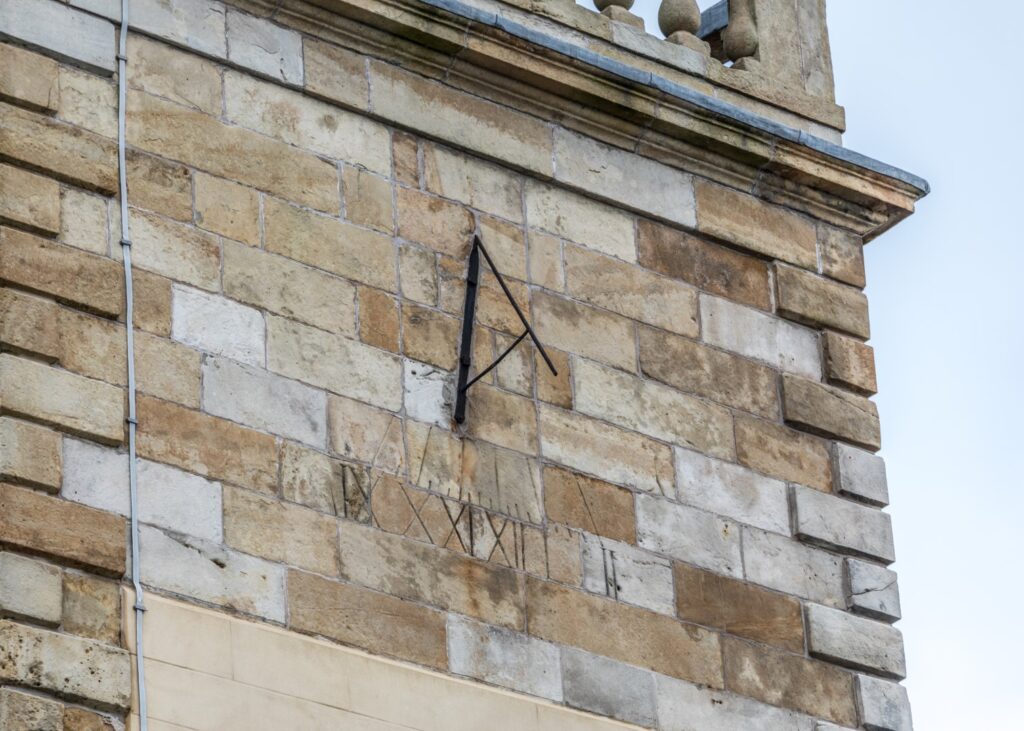
There is a sundial high up on the southern wall of the tower of Holy Trinity Church – a church locally known as ‘Boyd’s Church’. The sundial tells the time of day, when there is sunlight, by the position of the sun in the sky. A narrow rod, called a gnomon, (the Greek word for an indicator), casts a shadow on a flat dial on the wall where the hours of the day are marked. The hours are indicated in Roman numerals and are marked IX, X, X1, X11, I and 11, indicating the hours nine, ten, eleven, twelve and one and two o’clock in the afternoon.
There is some weathering of the sandstone on the tower which makes it difficult to make out some of the hours on the dial, and of course if it is overcast, with no sun, the sundial is useless for telling the time, which may explain the presence of a clock on the west-facing wall of the church.
Whilst the sundial on the wall on the wall of Boyd’s Church in Ballycastle would not have had the accuracy of modern day clocks or watches, it was useful for indicating the broad divisions of the day – morning, noon, afternoon and evening. These divisions were known as ‘tides’ and the word still survives in such terms as ‘noontide’ and ‘eventide’.
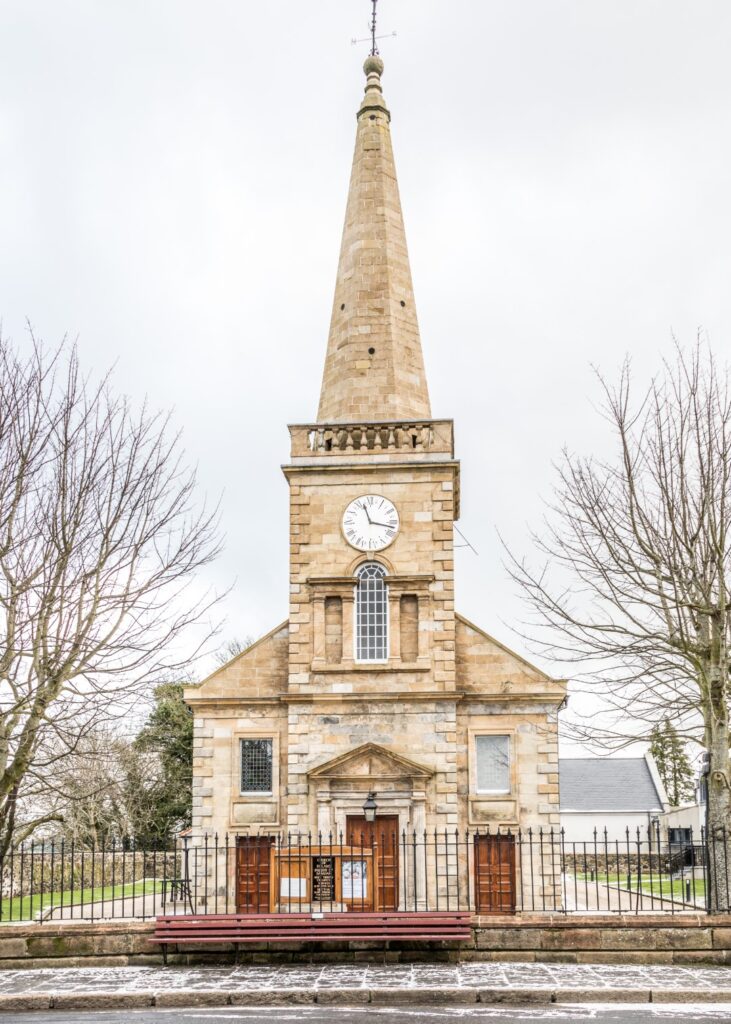
Façade of Boyd’s Church
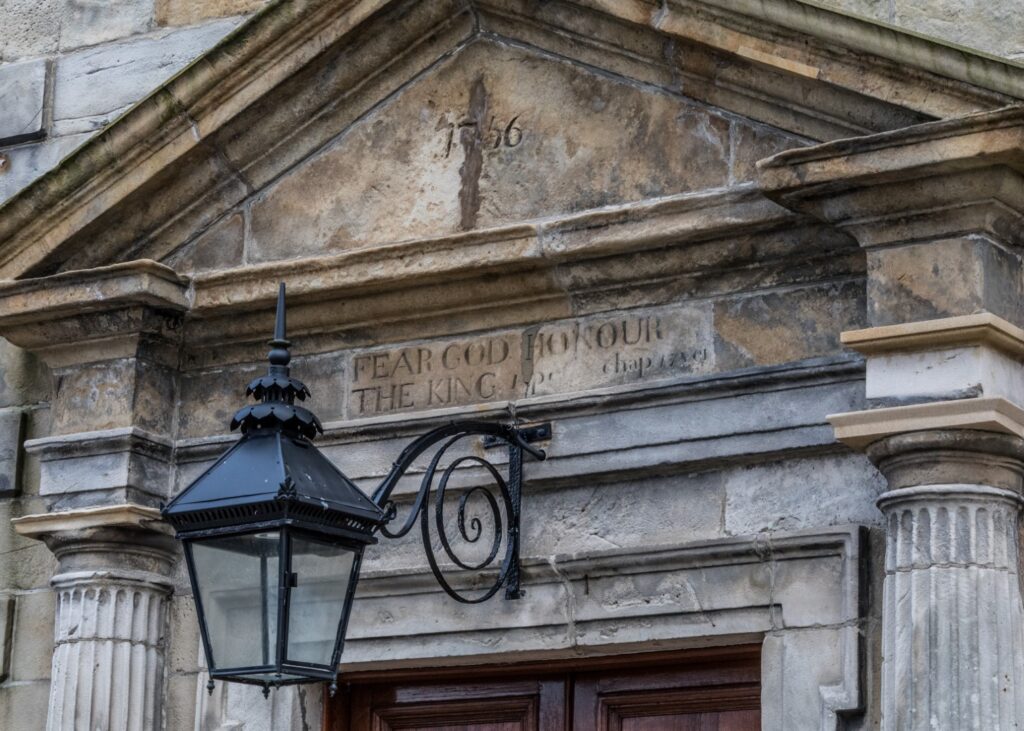
The Church of the Holy Trinity at the Diamond in Ballycastle is known locally as ‘Boyd’s Church’. It was built as a chapel of ease for the Boyd family in 1756, as the date above the door indicates. The church is of classical design, with fluted Doric half-columns on either side of the west-facing door which is surmounted by a pediment. There is a large clock-face on the tower above a Venetian-style window and above that a tower which encloses an eight-sided spire.
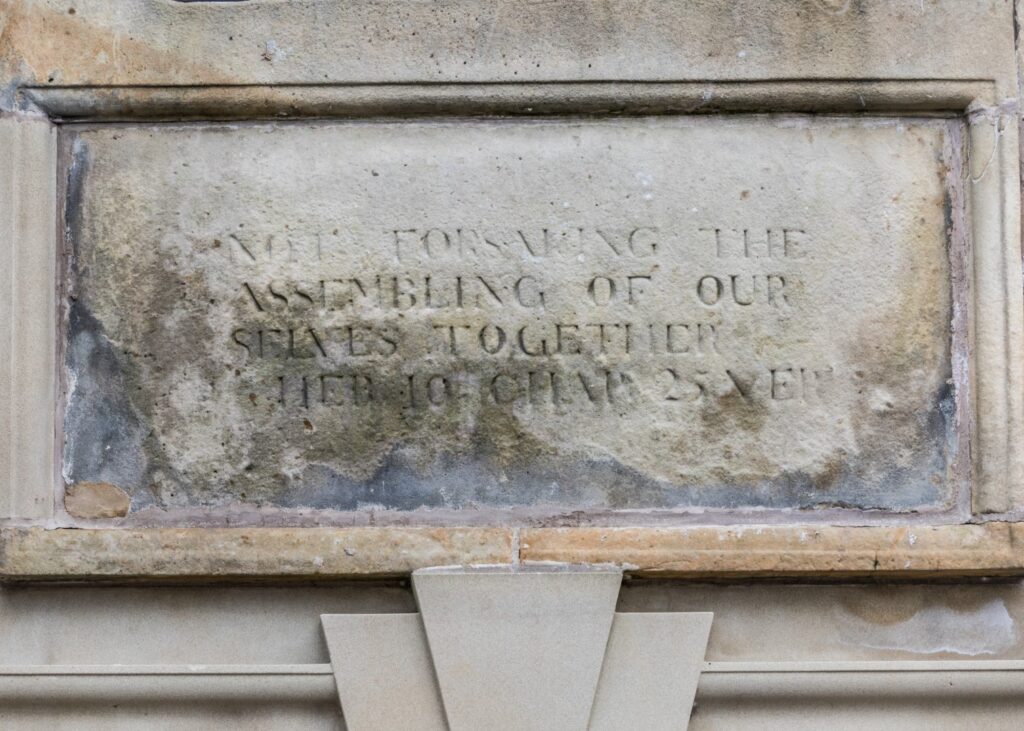
The Biblical inscription above the doorway reads: ‘Fear God / Honour the King’, a quotation from 1 Peter, 2 Chapter, Verse 17. Of the two stone plaques on either side of the square-headed doorway, the inscription on the one to the north reads: ‘Keep thy foot when thou / goest to the House of God and / be more ready to hear than / to give the sacrifice of fools’ Eccl, 5 Chap. 1 Ver.’ The quotation on the south plaque reads: ‘Not forsaking the / assembling of our / selves together’. Heb. 10 Chap. 25 Ver.’
There is some weathering on both plaques and on the inscription above the door, but all are still legible.
This post is part of the What’s That? Project. Funded by The Community Arts, Culture and Heritage Fund & The Community Foundation for NI. The aim of the project is to highlight local historical sites and give people a short history of what is there. Photos by John Healy.