
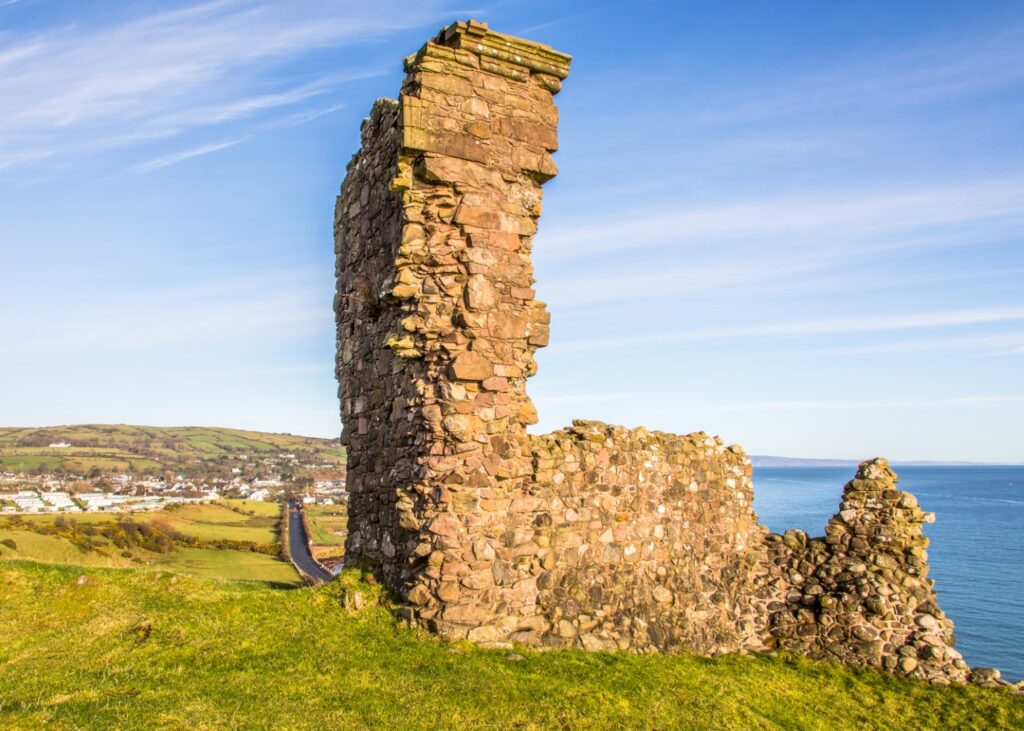
The ruin of Red Bay Castle stands prominently on the headland between Cushendall and Waterfoot and is easily seen from the Antrim Coast Road. A view of the south side of castle, which is on private land, can be had from the inland Middlepark Road. The present remains are one wall of a two-story Tower House constructed of local sandstone and which would have been about 12m by 7m externally and 6m in height. Interesting visible details are the decorative stone moulding at the top and the beam-holes for the floor timbers. Attached to the castle wall is a section of the curtain wall which would have surrounded the courtyard.
The story of this site gives an insight into 1000 years of local history. Anglo-Saxon coins from AD 839 were found nearby and the local name, Crookanavick, Hill of the Viewpoint, takes us back to the 12th century when the Gaelic O’Flinns controlled the area and would have fortified the promontory. They were followed by the Scoto-Norman Bissets who would have constructed a wooden fort on the raised area of the hill, the motte, and surrounded the remainder with a stockade, thus producing the bailey whose layout is easily seen from the inland side. During the 200 years of their Lordship of the Glens they may have strengthened this fort using local stone. In 1399, the marriage of Eoin Mor MacDomnhaill to Marjorie Bisset gave the McDonnells their claim to the Glens and eventually ownership of Red Bay Castle.
A stone castle was built on the site, in 1561, by the McDonnell chieftain, Sir James, the elder brother of Colla of Kenbane and Sorley Boy. In 1565 Shane “The Proud” O’Neill attacked the McDonnells, taking and burning the castle and the small town around it. Sir James and Sorley were taken prisoner and Sorley was released when Shane came for ill-fated negotiations at Cushendun in 1567. He repaired the castle in the following year. Sorley died in 1589 and his son, James of Dunluce dismantled Red Bay to use the stone in repairing his headquarters at Dunluce Castle. He was succeeded by his brother Randal, the first Earl of Antrim, who again restored the castle, in 1605, as he was obliged to have a garrisoned castle in each barony. Two generations of the Stewart family of Red Bay then held the castle as constables until it was finally reduced to its present state by Cromwellian forces in 1652.
The importance of Red Bay Castle in our local history is recognised in its use as the logo of the Glens of Antrim Historical Society.
This post is part of the What’s That? Project. Funded by The Community Arts, Culture and Heritage Fund & The Community Foundation for NI. The aim of the project is to highlight local historical sites and give people a short history of what is there. Photos by John Healy.
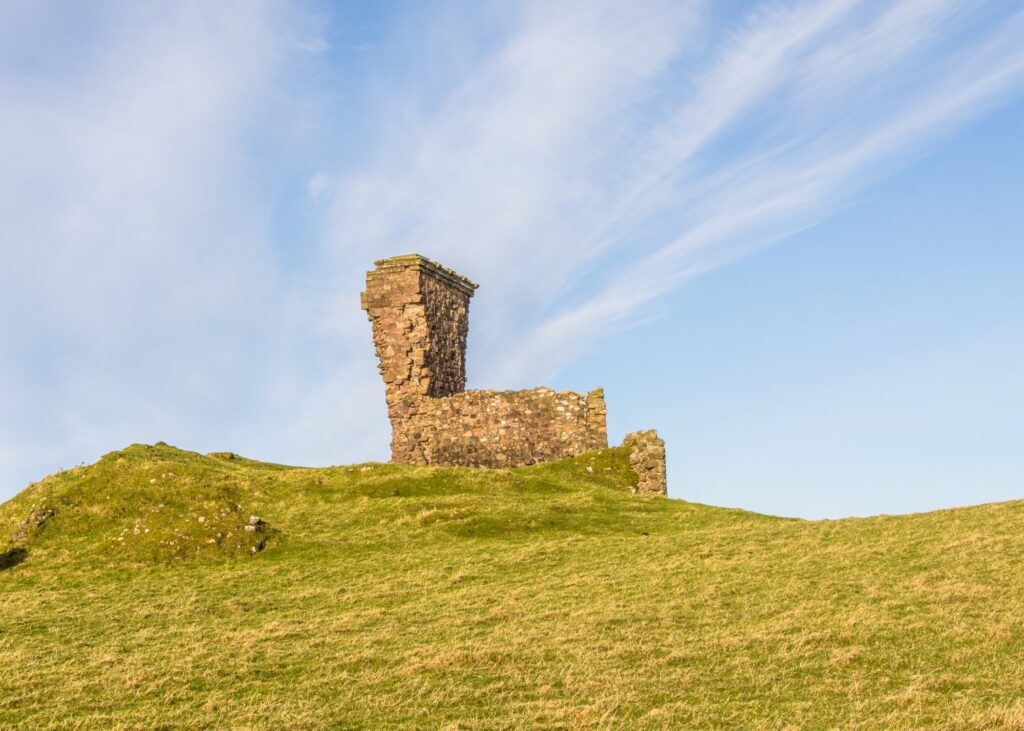

I visited the site recently, and I have the strong impression that there are still more remains of the castle under the grass.
Beautiful site. I believe my ancestors, a very very very long time ago, lived in the area. I’d give anything to do some digging there to see what gets uncovered!