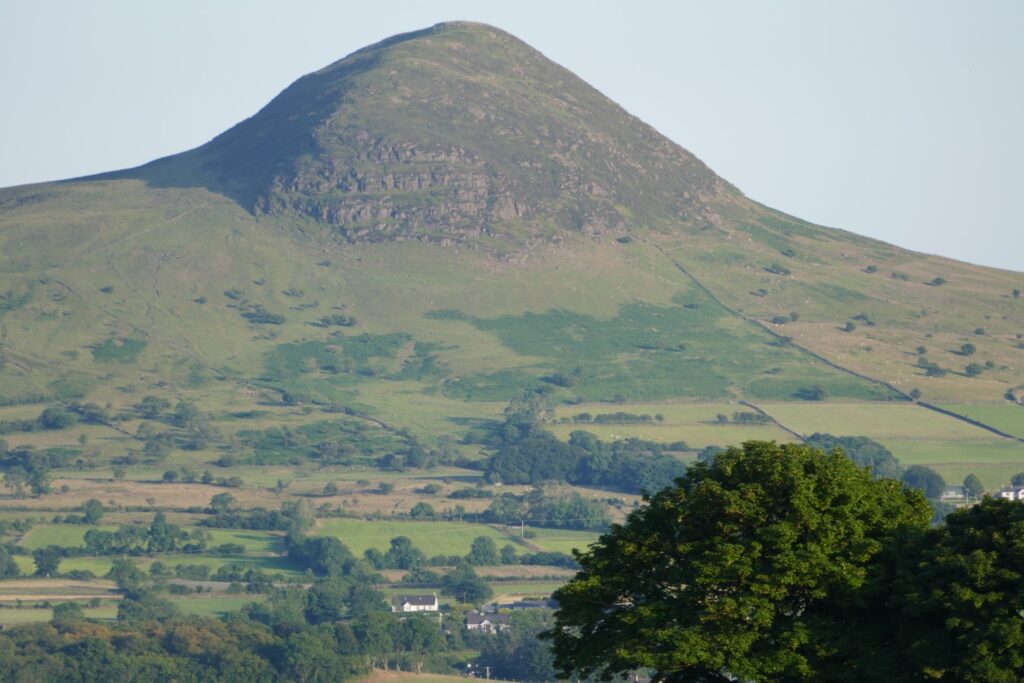
St. Patrick and Slemish mountain have been synonymous with each other for hundreds of years. Slemish remains a place of pilgrimage and interest especially around St. Patrick’s Day when crowds flock to it.
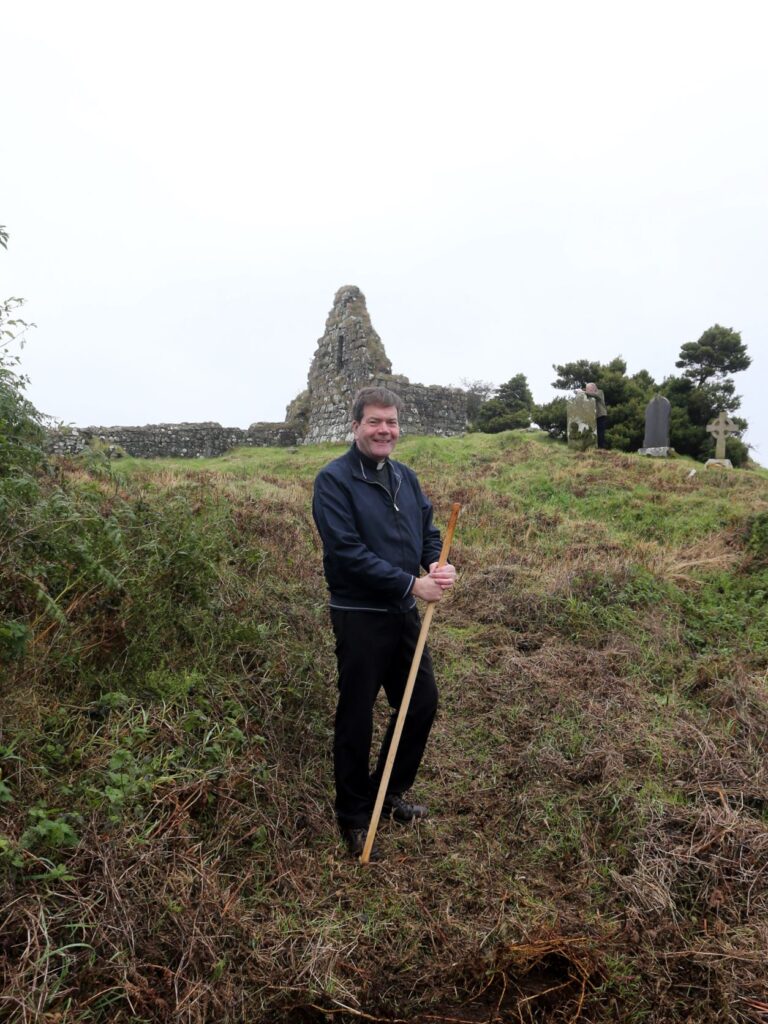
Opposite Slemish on Skerry Rock stands the ruins of Skerry Old Church and graveyard. Legend says that Milchu, the young Patrick’s slave master, seeing many of his followers including his two daughters converting to Christianity, locked himself and his possessions in his ‘palace’ and set fire to the lot. Patrick then built his first church on the site.
Leaving aside the legend, the ruler of this tuath or petty kingdom would most probably have had his stronghold on top of Skerry Hill which dominates the fertile ground of the valley. Tradition claims this was the first church founded by St. Patrick in the Braid valley though Eglish (which means ‘church’) two miles away, can lay equal claim. There are no ruins of Eglish visible today.
It is a fact that Skerry Old Church was recorded in the Taxation of Pope Nicholas (c.1300) and there is some evidence that it was refurbished in later Medieval Times. It probably fell into disuse at the time of the Dissolution of the Monasteries, (1540). The O.S. Memoirs claim that there had been a range of monastic buildings on the site.
A vault that has remained intact and is part of the church building is the burial place of the O’Neills of Clandeboy, descendants of Niall of the Nine Hostages and High Kings of Ireland.
The graveyard wall was rebuilt in 1819 but successive references refer to the church as a ruin. Facts can be hard to establish; one source claims the Irish burned it down in 1641 when Scottish and English settlers took refuge in it; another source says the Irish stole the saddles of the horses belonging to William’s soldiers who then burned the church.
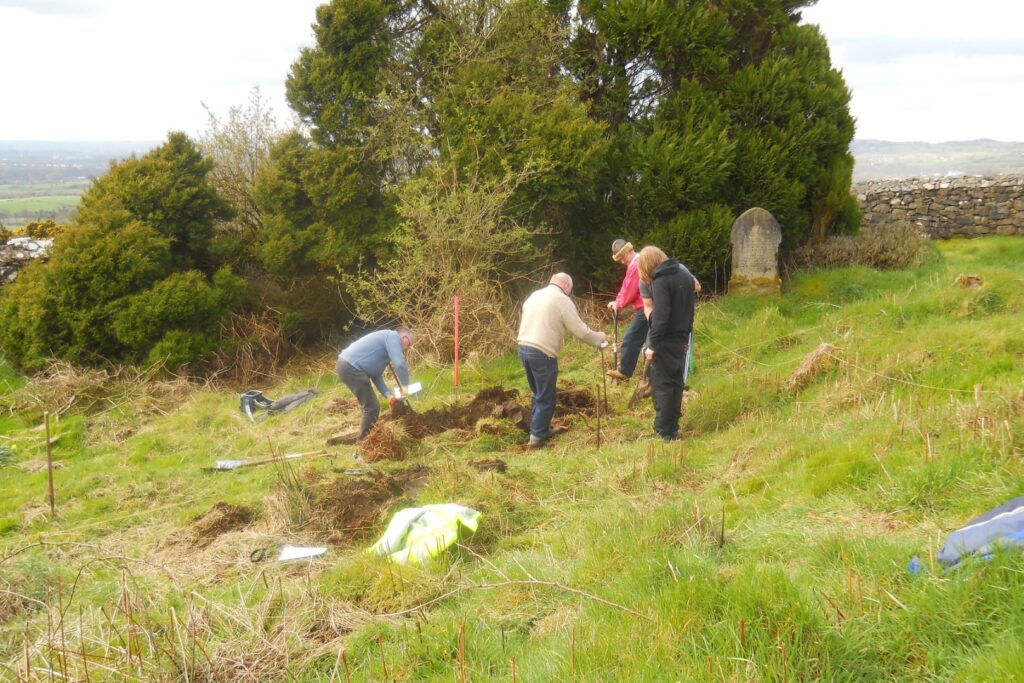
Despite it being a ruin it remained a place of pilgrimage up until the early 1800s. Some families of long-standing in the area continued to bury there until the late twentieth century.
It is an area teeming with archaeological and historical sites from 3500 BC – the portal grave at nearby Ticloy – the Celts and their raths – Christianity from its birth in Ireland – the Scottish settlers with their different culture.
The establishment of a church at Brecagh and later a church and graveyard at Aughafatten- nearer the main centre of population led to the near abandonment of the Old Church. A few, because of ancestral and historic ties, continued to bury here despite the difficult access.
Slemish resonates with stories of Patrick the slaveboy and shepherd, however, The Old Church and graveyard would be a more tangible reminder of the coming of Christianity to the Braid Valley and Ireland – the dominance of the site and the beauty of its surroundings – the imposing church gable hundreds of years old – the names on the gravestones, many are still intact, ancestors of present-day Braid people, some long forgotten, the vault of the O’Neills once the High Kings of Ireland. This is the culture and heritage of this area.
For a returning emigrant or interested visitor, a visit to Slemish and its complement, The Old Church, must rival a visit to Saul, Slane or Croagh Patrick, but presently access, which is off the Loughloughan Road, is very difficult.
It is an area where churches, schools, shrines and wells are dedicated to St. Patrick and most enduring and foremost among these would be Skerry Old Church.
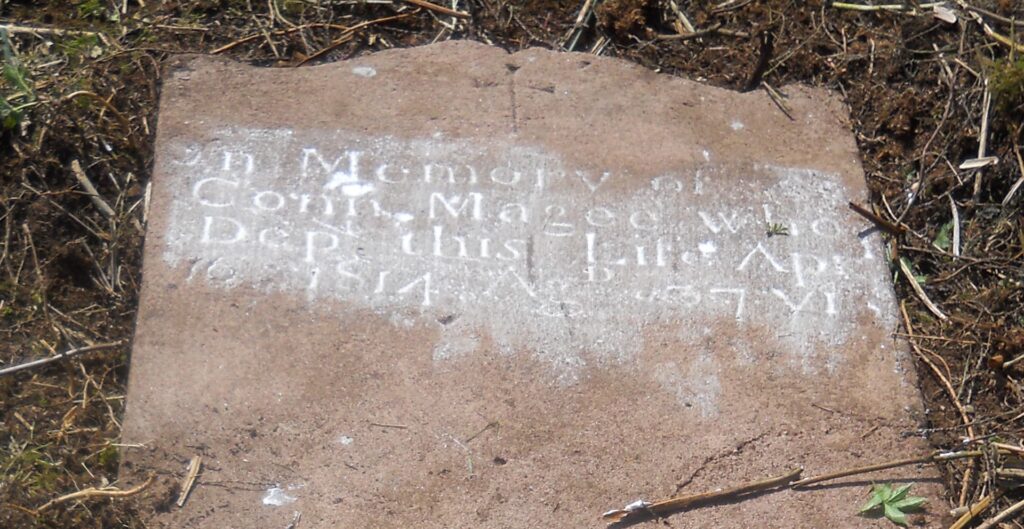
Con Magee, a 1798 rebel and after whom the Glenravel Gaelic club is called, is buried in the graveyard.
The parishes of The Braid and Glenravel were once united under the name St Patrick’s (Skerry). They were separated in 1878, The Braid, not surprisingly kept the name St Patrick’s (Skerry) while Glenravel became St Mary’s but also retained the historic name ‘Skerry’. One hundred and forty years later when Fr Gabriel Lyons was Parish Priest of Glenravel (2008-2019) the two parishes were once again reunited.
This post is part of the What’s That? Project. Funded by The Community Arts, Culture and Heritage Fund & The Community Foundation for NI. The aim of the project is to highlight local historical sites and give people a short history of what is there.