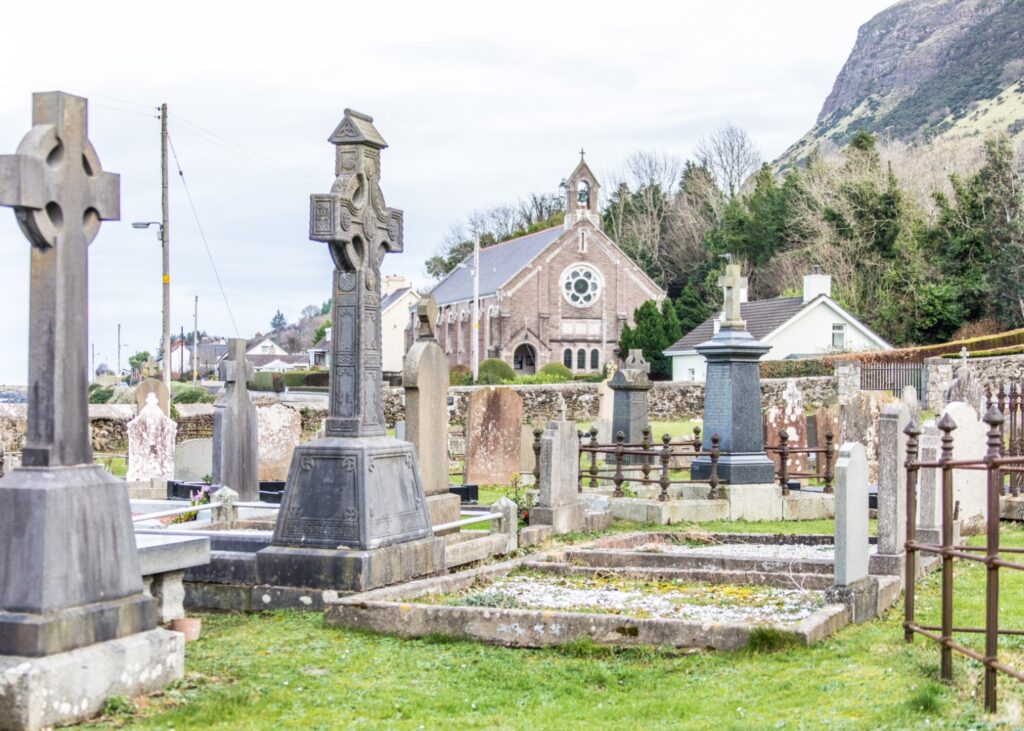
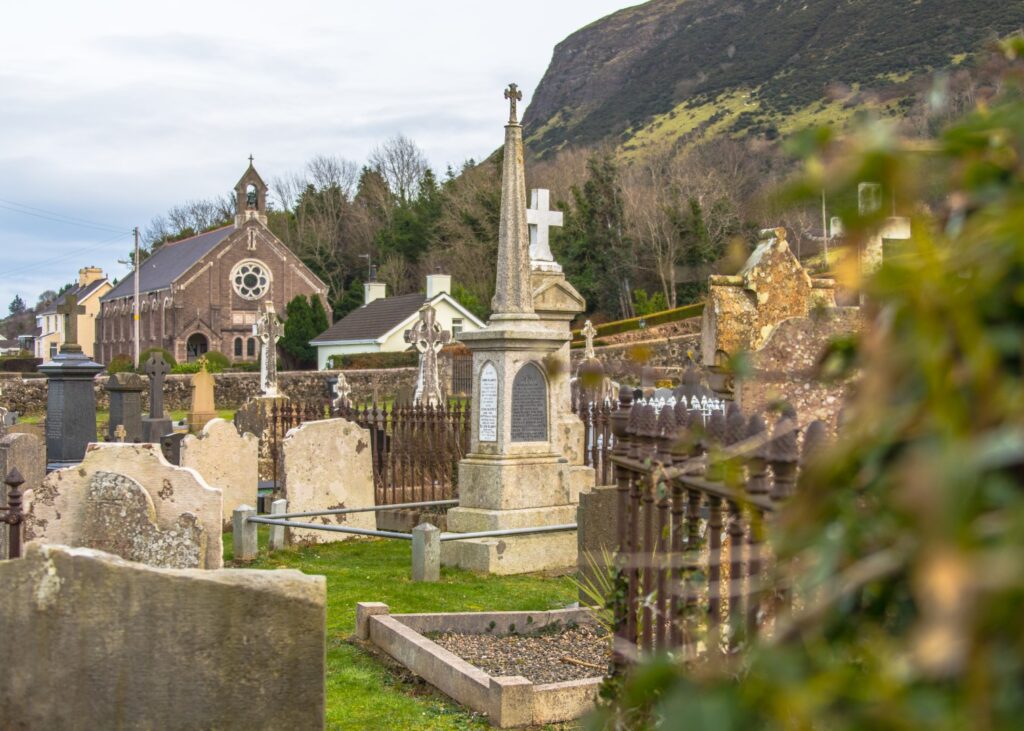
The Church of St Patrick and St Brigid must be one of the most scenically situated churches in the country and, tucked into a corner of Red Bay, its simple architecture complements its surroundings. Completed in 1917, the walls are of local sandstone which was sourced from a quarry in Coskib townland near Cushendall, and unusually for its time, were constructed with a cavity. The church building was refurbished in 1999 by John McCollam of Cushendall whose grandfather Daniel was responsible for building the apse.
Internally, the walls and floor of the apse are finished with ornate and colourful mosaic which includes representations of the four evangelists. This work was carried out by craftsmen from the firm of Ludwig Oppenheimer and has been described as “a legacy of inspiration and beauty”. The stained-glass windows, by the renowned Michael Healy, in the apse are described by Frank Rogers as “three of the most delightful windows to be found anywhere in the Glens of Antrim”. First is St Patrick, shown preaching with a both a convert and possibly a druid at his feet. In the centre the Risen Christ appears to the disciples at the Sea of Tiberias while the third shows St Brigid dressed in royal purple and distributing alms.
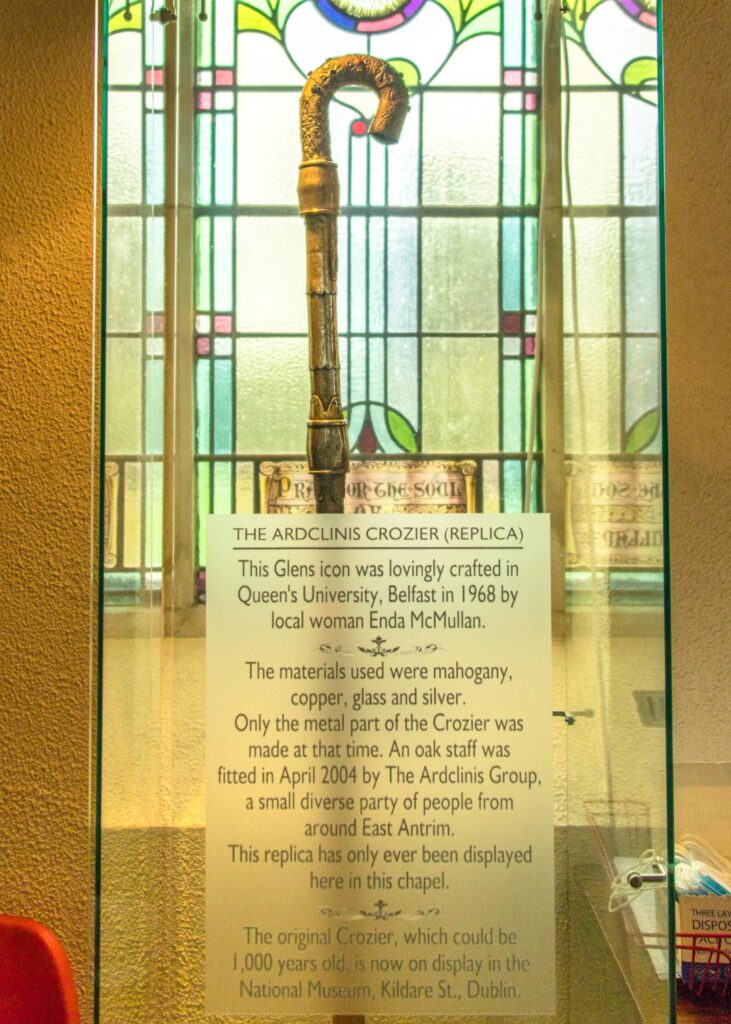
In the entrance hallway of the church is displayed a replica of the Ardclinis Crozier, now in the National Museum, Dublin. The story of the Crozier will be given in the history of Ardclinis Church.
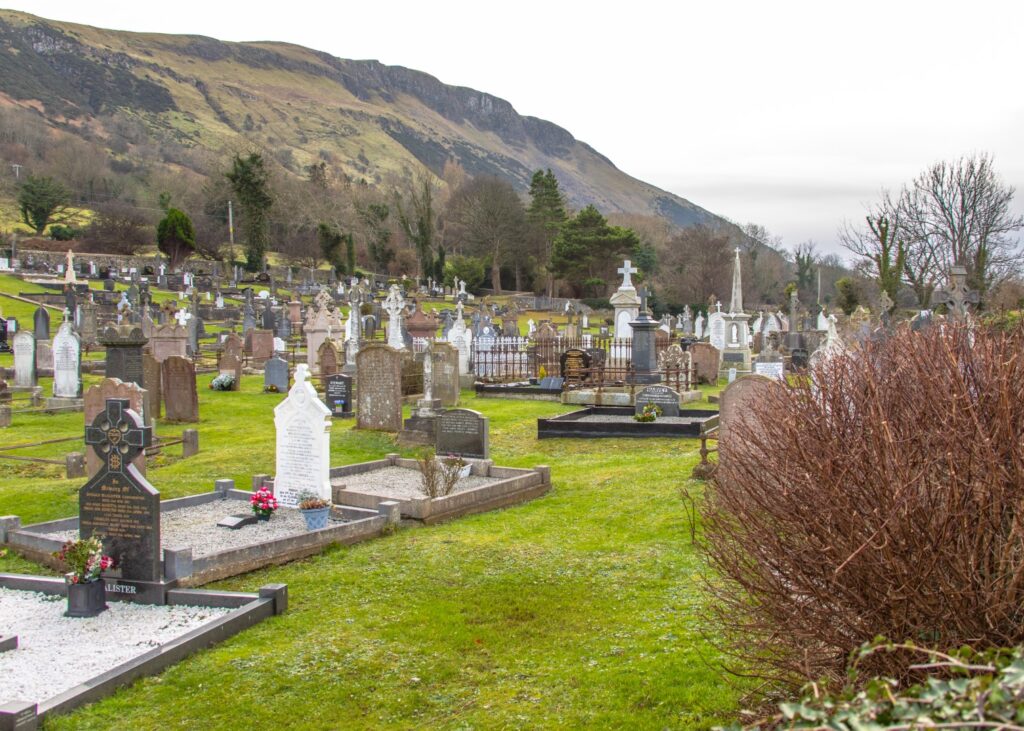
The earlier Church of St Killian was nearby and its outline is marked by four granite pillars in the cemetery near the entrance from the coast road. It was dedicated in 1839 just ten years after Catholic Emancipation was achieved and was destroyed by an accidental fire in 1915. The cemetery is more extensive than might be expected and this is because prior to 1967 Glenariffe was part of Cushendall Parish and the cemetery served both areas. Thus, many of the family and townland names for a wide area are recorded on the headstones. The oldest visible memorial is to Patrick McAuley of Corlean who died in 1819. Many from this area went to sea and a memorial to those who perished, including their names, was erected in the cemetery.
References: Glass in the Glens, Frank Rogers, 2004. A Glimpse at Glenariffe, McAllister & Sharpe, 1997.
This post is part of the What’s That? Project. Funded by The Community Arts, Culture and Heritage Fund & The Community Foundation for NI. The aim of the project is to highlight local historical sites and give people a short history of what is there. Photos by John Healy.