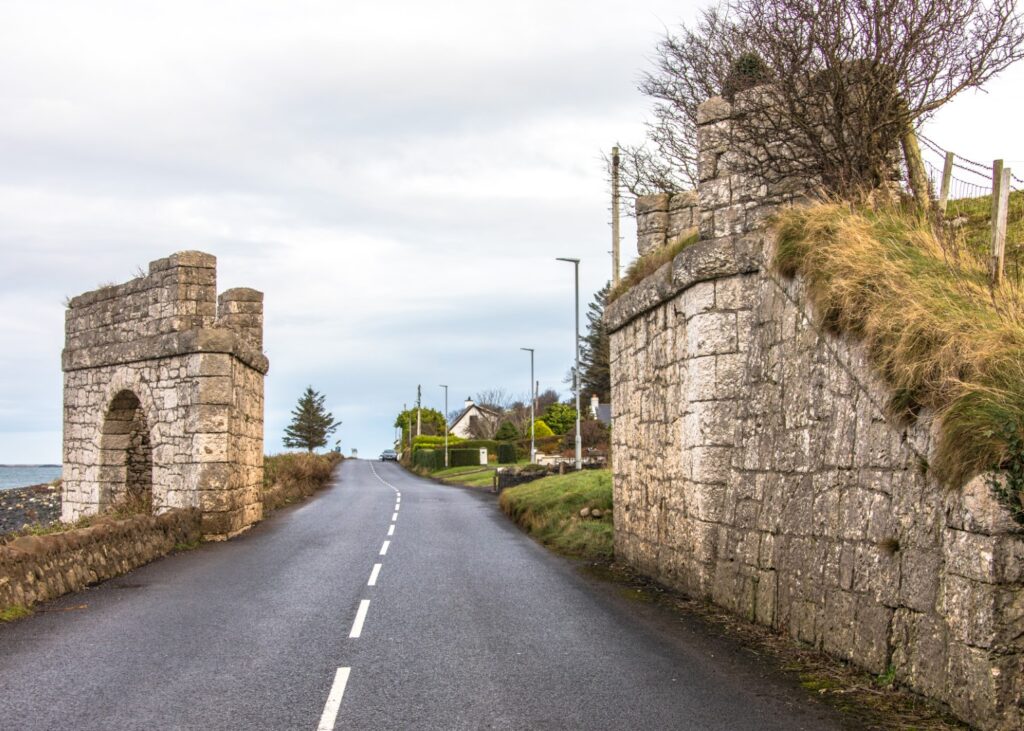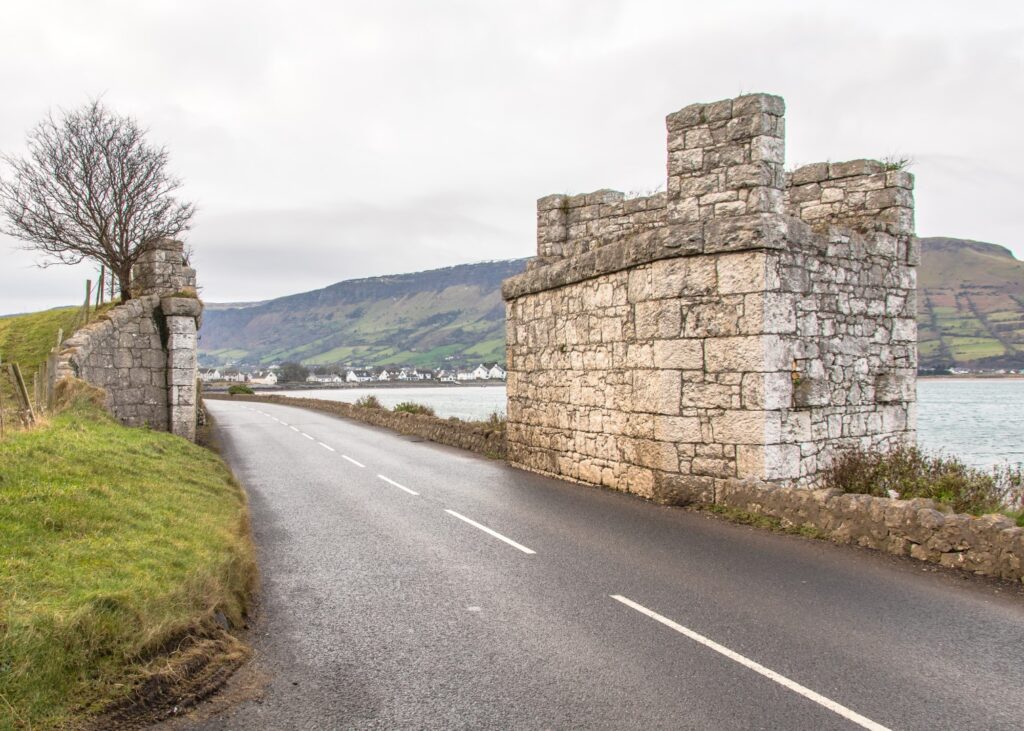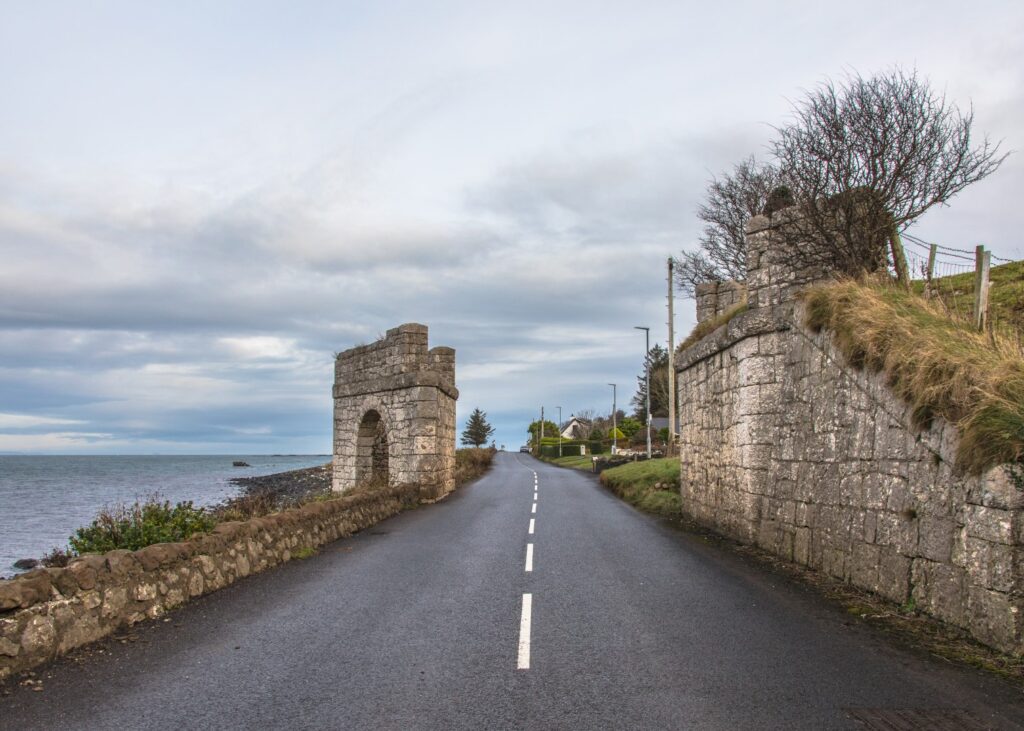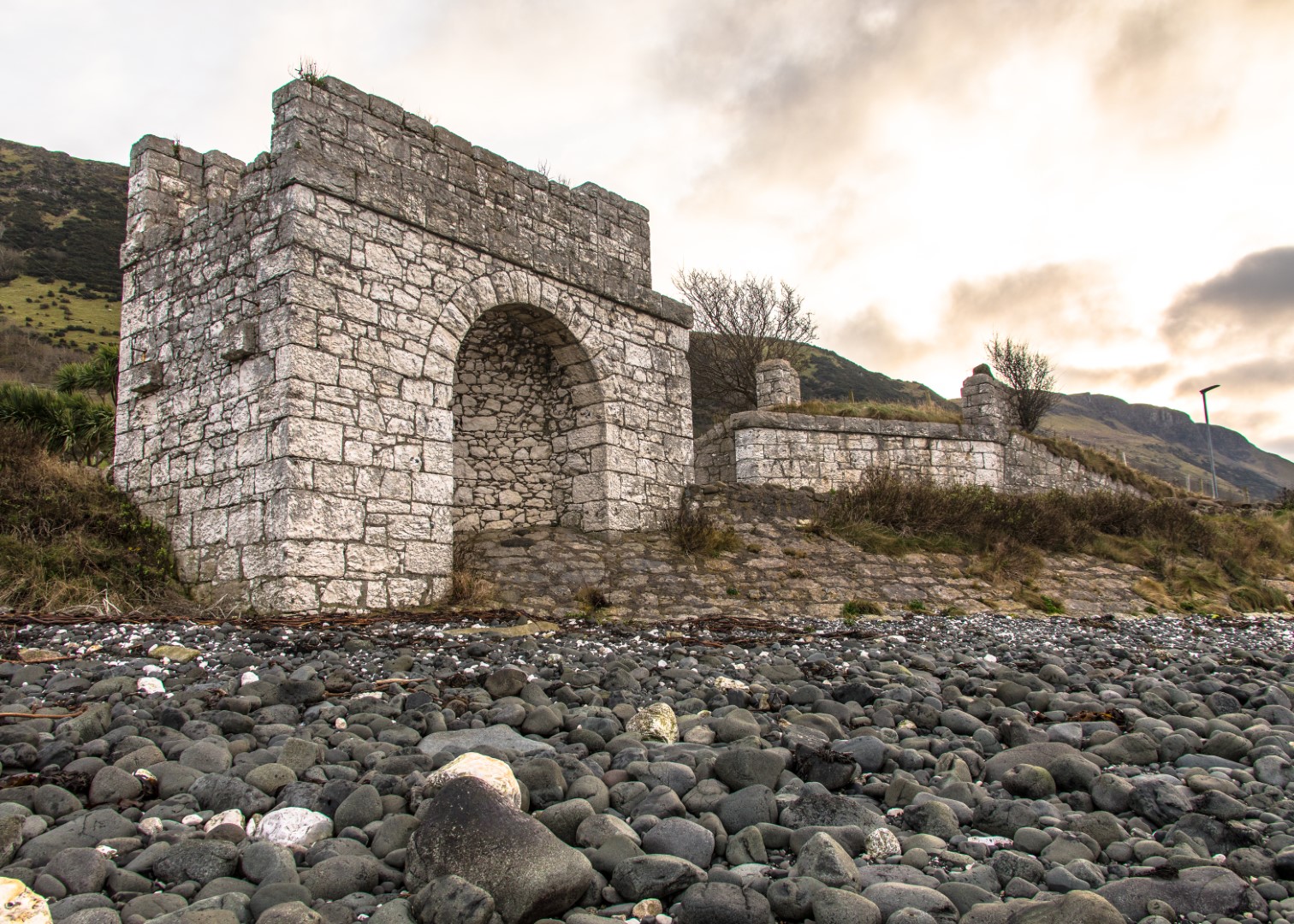
The limestone supporting walls or abutments on either side of the Antrim coast road, to the eastern side of Glenariff in the townland of Carrivemurphy, are the most visible relic of a railway which carried iron ore from Cloghcor, at the head of the glen, to the coast. In the mid-19th century, the Antrim hills had become the greatest iron ore mining area in Ireland. Nearby, in the sea, can be seen the remnants of the pier which was also constructed by the Glenariff Iron Ore and Harbour Company. The terrace of houses beside the road were for mine and railway employees and the former engine shed lies behind them.
Work on preparing the route for the railway along the eastern side of Glenariff commenced in 1873 and the White Arch and a wrought iron bridge spanning the abutments was constructed by the end of October of that year. What is now visible in the sea are parts of the concrete base of the pier on which was built a timber superstructure carrying the railway lines so that ore could be poured from the loaded wagons directly into the holds of sailing ships. The ore was then transported to Cumbria, South Wales and Glasgow for smelting.
The intense activity in this area can only be imagined as engines and wagons arrived from the mine, were backed into a network of sidings, wagons were disconnected and drawn by horses onto the pier and unloaded to be drawn again four miles up the valley to Cloghcor. The track of the railway can still be discerned along the hillside. Mining continued in Glenariff until 1881 but economic pressures then led to closure and a bankruptcy sale in 1885. Lord Antrim, the landowner bought the rails but left them in place. In 1890 three miles of heavy steel rails were removed overnight, never to be seen again!
A network of narrow-gauge railways developed throughout Ireland and followed the example of the Glenariff line which was the first to use a 3ft gauge and the White Arch is still a memorial to this part of our local and national heritage protected for posterity.
This post is part of the What’s That? Project. Funded by The Community Arts, Culture and Heritage Fund & The Community Foundation for NI. The aim of the project is to highlight local historical sites and give people a short history of what is there. Photos by John Healy.